Tag Archives: Order Status

PayPal Says Paid, WooCommerce Says Pending: Fixing PayPal Order Status Problems

PayPal is one of the most popular ways to pay on WooCommerce stores, and one of the most common sources of “it says pending but I paid” support tickets.

Search the WordPress.org forums and the titles tell the story: “Payments succeed in PayPal but WooCommerce doesn’t update status”, “PayPal payments stay on pending”, “PayPal IPN notifications do not arrive”, “Webhook resubscription fails”, “PayPal: order paid but on failed status”. Some of these threads are a decade old. Others are from this year. The integration has changed several times, but the shape of the problem hasn’t.

This guide explains how PayPal tells WooCommerce about a payment, why that message gets lost, how to diagnose which part failed, and how to stop paid PayPal orders from being missed.

How PayPal confirms a payment to WooCommerce
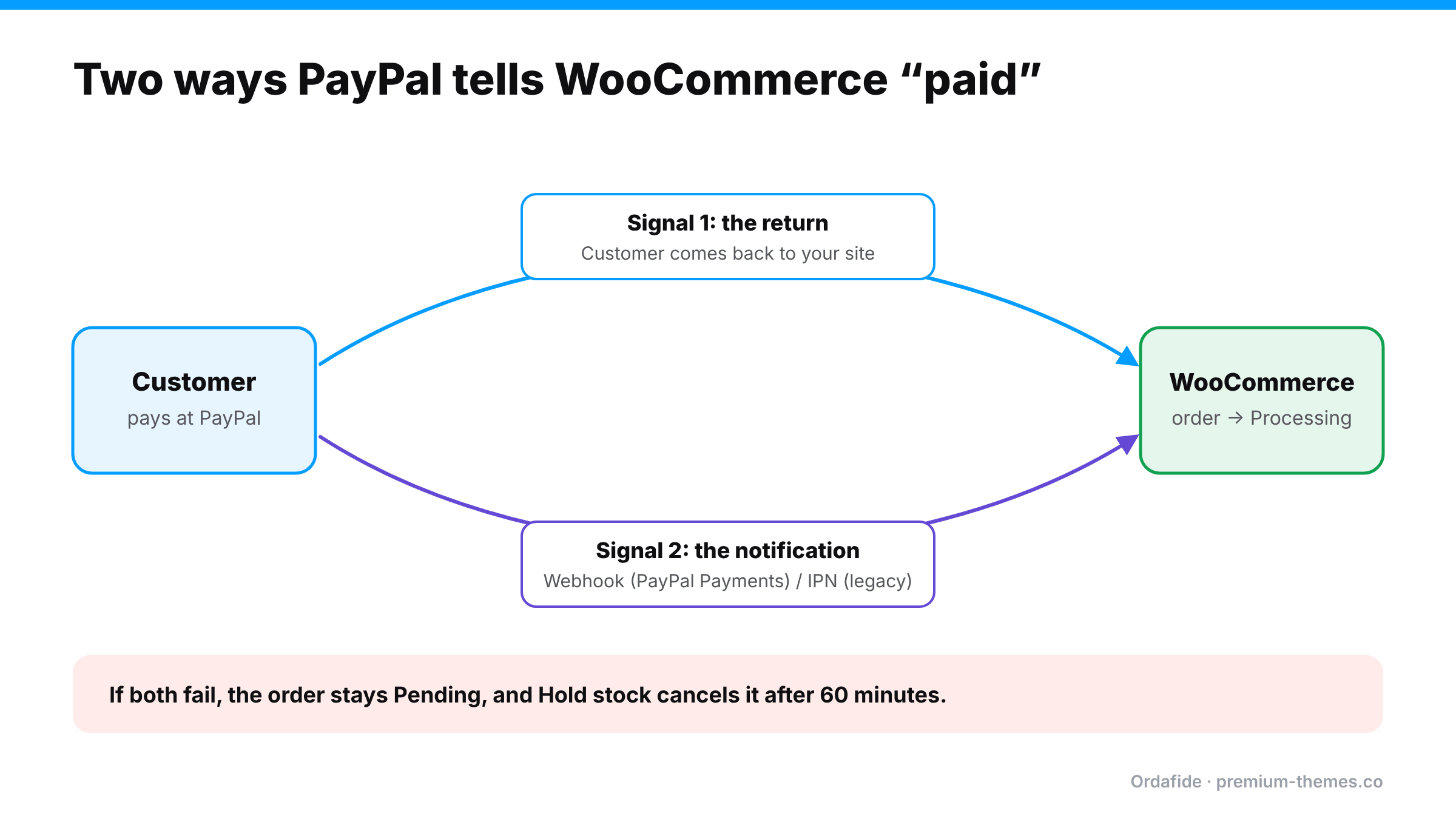
Diagram: after a customer pays at PayPal, WooCommerce learns about it either when the customer returns to the site, or through a server notification (webhooks for PayPal Payments, IPN for legacy PayPal Standard). If both fail, the order stays Pending and the Hold stock timer cancels it after 60 minutes.

PayPal checkout involves the customer leaving your page (or a PayPal popup appearing over it), so WooCommerce relies on two signals:

  1. The return. After paying, the customer is sent back to your site. The plugin can confirm the payment at that moment.
  2. The notification. PayPal’s servers send a message directly to your site: webhooks for the current WooCommerce PayPal Payments plugin, and IPN (Instant Payment Notification) for the legacy PayPal Standard.

If both signals fail, the order never moves. The customer closed the popup or tab before returning, and the notification was blocked or rejected. If the order also uses the Hold stock timer, WooCommerce auto-cancels it an hour later.

Which PayPal integration are you using?

This matters because the fixes differ.

Integration How notifications work Status
WooCommerce PayPal Payments Webhooks registered automatically with your PayPal account Current, recommended
PayPal Standard (built into older WooCommerce) IPN to a notify URL Legacy. WooCommerce has deprecated it
Third-party PayPal plugins Varies Check the plugin’s documentation

If you’re still on PayPal Standard, migrating to PayPal Payments is worth doing for many reasons, and this is one of them.

Why PayPal orders get stuck

1. Webhooks not registered, or registered to the wrong URL

PayPal Payments subscribes to webhooks for your site’s URL when you connect your account. If you changed domain, moved from staging to live, switched HTTP to HTTPS, or restored a backup, the webhook may point to the wrong place. The plugin’s settings include an option to resubscribe webhooks. Forum threads show this fixing many cases, and occasionally failing because something else (usually a firewall) blocks the subscription check.

2. A firewall or security plugin is blocking PayPal

Exactly like Stripe webhooks, PayPal’s notifications are automated POST requests that bot protection, WAFs and security plugins love to block. (Firewall blocking webhooks)

3. Sandbox and live mixed up

Connecting a live store to a sandbox account (or the reverse), or switching modes without reconnecting, leaves notifications going to the wrong environment.

4. The customer didn’t return to your site

Closing the PayPal window, a lost connection, or an in-app browser that doesn’t hand control back. That’s normal and expected, which is why notifications exist. It becomes a problem only when notifications fail too.

5. eChecks and payment review

Some PayPal payments are genuinely pending at PayPal: eChecks that take days to clear, payments held for review, unverified addresses, currency conversion acceptance. Those orders should wait. The fix is patience, not intervention. Always check PayPal’s actual status before acting.

6. Authorize instead of capture

If the plugin is set to authorize rather than capture, orders may sit On hold until you capture. (Authorized vs captured)

7. Background processing stalled

Parts of order processing can depend on WordPress’s background queue. If WP-Cron or Action Scheduler isn’t running, follow-on work stalls. (Loopback request failed)

Diagnosing a stuck PayPal order
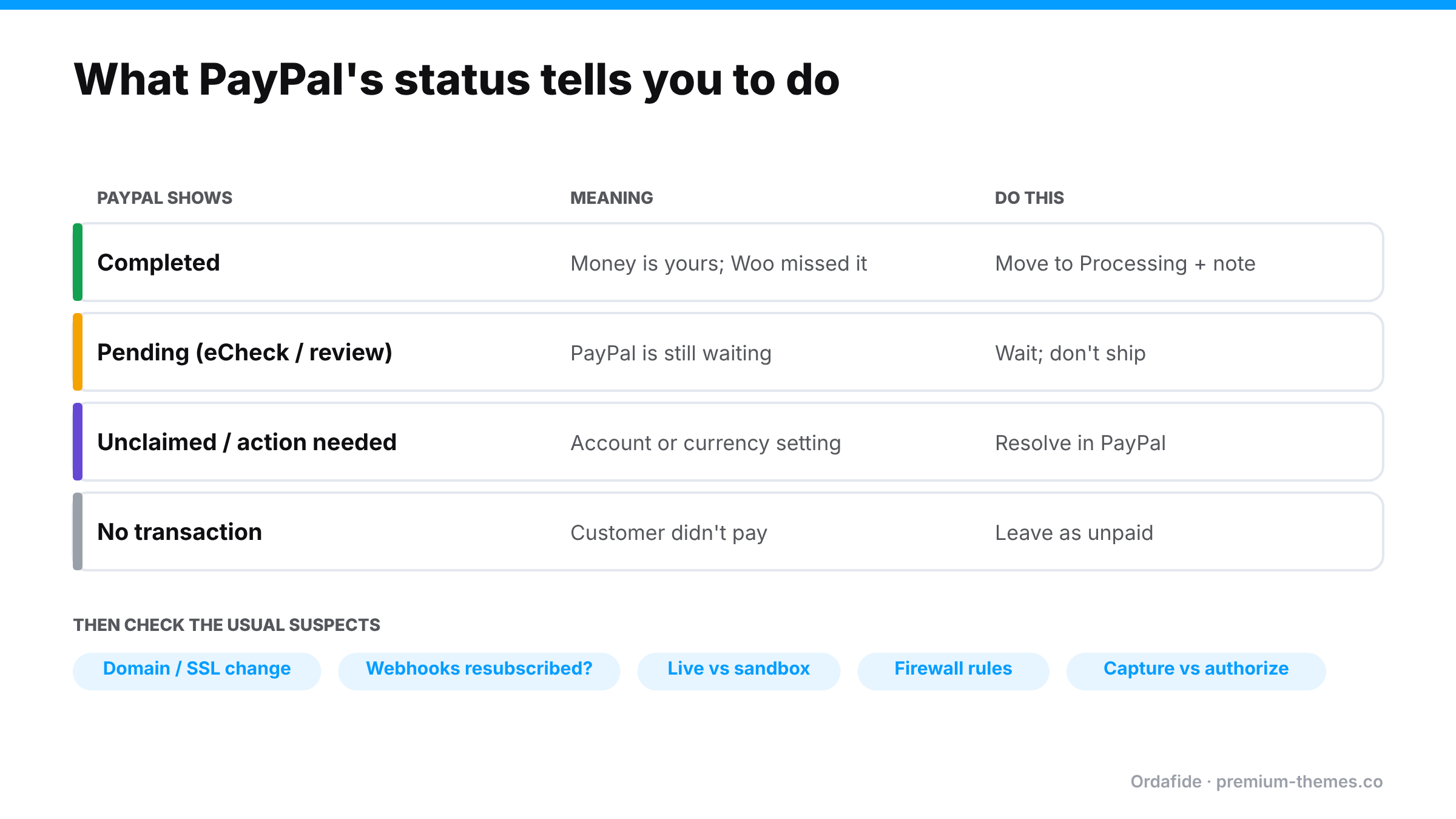
PayPal Completed means move the order to Processing; Pending for eCheck or review means wait; Unclaimed means resolve in PayPal; no transaction means the customer didn't pay. Then check domain or SSL changes, webhook subscription, live versus sandbox, firewall rules, and capture versus authorize.

1. Find the transaction. Open the order notes for a PayPal order or transaction ID. Search it in your PayPal account’s activity.

2. Read PayPal’s status.

  • Completed: the money is yours. WooCommerce missed the message.
  • Pending (with a reason): PayPal is waiting (eCheck, review, unclaimed). Don’t ship yet.
  • Unclaimed / requires action on your side: often currency or account settings. Resolve it in PayPal.
  • No transaction found: the customer didn’t pay; the order is genuinely unpaid.

3. Check the plugin’s connection and webhook status in WooCommerce → Settings → Payments → PayPal. Is it connected to the right environment (live vs sandbox)? Are webhooks subscribed? Try resubscribing.

4. Enable logging in the plugin’s settings, place a small test payment, and read the log for errors on the notification.

5. Check security layers (CDN, security plugin, host WAF) for blocked requests from PayPal around the payment time.

A worked example: the domain change

A store moves from shop.example.com to example.com and sets up a redirect. Everything looks fine: the site loads on the new domain, PayPal checkout works, customers return to the new domain after paying.

But PayPal Payments’ webhooks are still subscribed to the old domain. Notifications go to shop.example.com, hit a 301 redirect, and webhooks don’t follow redirects. Every notification fails.

  • Customers who return to the site after paying are fine, because the return confirms the payment.
  • Customers who close the PayPal window early, or whose phone drops the connection, are left on Pending payment. After an hour, the Hold stock timer cancels their orders.

Roughly one PayPal order in eight ends up cancelled despite being paid. Nobody connects it to the domain change made two weeks earlier.

Fix: resubscribe webhooks in the PayPal Payments settings so they point at the new domain, then reconcile the cancelled orders against PayPal.

Questions to ask whenever PayPal orders misbehave

  1. Has the domain, SSL or hosting changed recently?
  2. Is the plugin connected to live or sandbox?
  3. When were webhooks last resubscribed?
  4. Has anything changed in the CDN, firewall or security plugin?
  5. Is the plugin set to capture or authorize?
  6. Does PayPal itself show the payment as Completed, or Pending with a reason?

Most cases are solved by question 1, 3 or 4.

Fixing the orders you already have

For each order PayPal shows as Completed:

  1. Move the WooCommerce order to Processing.
  2. Add a note: PayPal transaction ID, amount, “verified in PayPal on [date]”.
  3. If it was auto-cancelled, check stock.
  4. Send the confirmation email and a short apology.

For orders PayPal shows as Pending, leave them and set a reminder. For no transaction, the order is genuinely unpaid.

Preventing it

  • Use WooCommerce PayPal Payments, kept up to date.
  • Resubscribe webhooks after any domain, SSL, migration or staging change.
  • Keep sandbox and live strictly separate, and make sure staging sites never connect to your live PayPal account.
  • Allow PayPal’s notifications through your CDN, security plugin and host firewall.
  • Use capture, not authorize, unless you have a reason.
  • Keep background processing healthy.
  • Watch for paid orders that don’t move, automatically.

Why PayPal problems come in clusters

Stripe problems often affect one order at a time. PayPal problems tend to affect all PayPal orders from a certain moment, because the most common causes are configuration changes: a domain change, a webhook subscription that lapsed, a new firewall rule, a sandbox/live mix-up. That has two consequences:

  1. The damage grows fast. Every PayPal order after the change is at risk, not just one.
  2. The fix is usually one setting, applied once, followed by reconciling the affected orders.

So the most valuable thing is noticing the first stuck PayPal order quickly. Once you see one paid PayPal order sitting on Pending, check the others from the same period, then check what changed around that time.

Testing PayPal properly after changes

After any change to domain, hosting, security or the PayPal plugin, do a real end-to-end test:

  1. Pay with PayPal and close the PayPal window immediately after approving, without returning to the store.
  2. Wait a few minutes and check whether the order moves to Processing anyway.

If it does, notifications are working. If it only updates when you return to the site, the notification path is broken and customers who don’t return will be left on Pending.

How Ordafide catches stuck PayPal orders

Because PayPal involves a redirect or popup and a notification, it’s one of the most failure-prone payment flows. Stuck PayPal orders tend to come in clusters, when something changes and every notification starts failing.

Ordafide Order Integrity for WooCommerce (free) flags:

  • Stuck payment: orders on Pending payment or Failed that carry a gateway payment reference
  • Paid but cancelled: orders with a confirmed payment date sitting in Cancelled or Failed with nothing refunded
  • Customer never emailed: paid orders that never got a confirmation
  • Background queue health, with a loopback test

Each finding explains what to check in PayPal before you change anything. If WooCommerce itself recorded a confirmed payment date, Ordafide can restore the order to Processing with one logged, reversible click.

Ordafide Pro connects to PayPal (as well as Stripe, Square, Mollie and Razorpay) with read-only credentials and reconciles what PayPal actually collected against WooCommerce. That catches the cases the free plugin can’t see, where no payment reference ever reached the order, or no order exists at all. It flags money with no order, paid orders with no payment, amount disagreements and refunds made in PayPal but missing in WooCommerce, with alerts to Slack, SMS, email or webhook. Because the credentials are read-only, Ordafide can’t capture, refund or move money.

A note on PayPal and refunds

The same notification problems that leave payments stuck can also leave refunds unrecorded. If you refund a PayPal payment from the PayPal dashboard and the notification doesn’t arrive, WooCommerce still shows the order as paid, stock isn’t restored and your revenue is overstated. Refund from the WooCommerce order screen wherever possible, so the plugin records the refund itself. (Refund status mismatches)
WooCommerce Failed Orders: What They Mean, When They’re Actually Paid, and What to Do

Every WooCommerce store has a few Failed orders. Most are harmless: a card declined, a customer gave up. So most store owners learn to ignore them.

That habit is expensive, because a small share of Failed orders aren’t failed at all. The customer was charged. The money is in your gateway. WooCommerce just recorded the wrong outcome. The WordPress.org support forums are full of threads titled things like “Customer payment says failed but it has been drawn from their bank account” and “Successful Stripe payments after failure, yet WooCommerce order failed”.

This guide explains what Failed means, how to tell a genuine decline from a paid order recorded as failed, and what to do with each.

What “Failed” means in WooCommerce

WooCommerce marks an order Failed when a payment attempt doesn’t go through. The order usually moves from Pending payment to Failed, and the gateway adds an order note explaining why.

Typical genuine causes, as WooCommerce’s own guide to failed orders lists them:

  • Declined card: insufficient funds, expired card, spending limits, wrong details
  • Authentication problems: wrong or expired API keys, a suspended gateway account
  • Duplicate-transaction protection: the gateway rejects what looks like a repeat submission
  • Site issues: outdated plugins, conflicts, server problems

By default, WooCommerce sends the admin a failed-order email but not the customer. Many customers who fail at checkout simply try again or leave.

The dangerous minority: “failed” orders that were paid

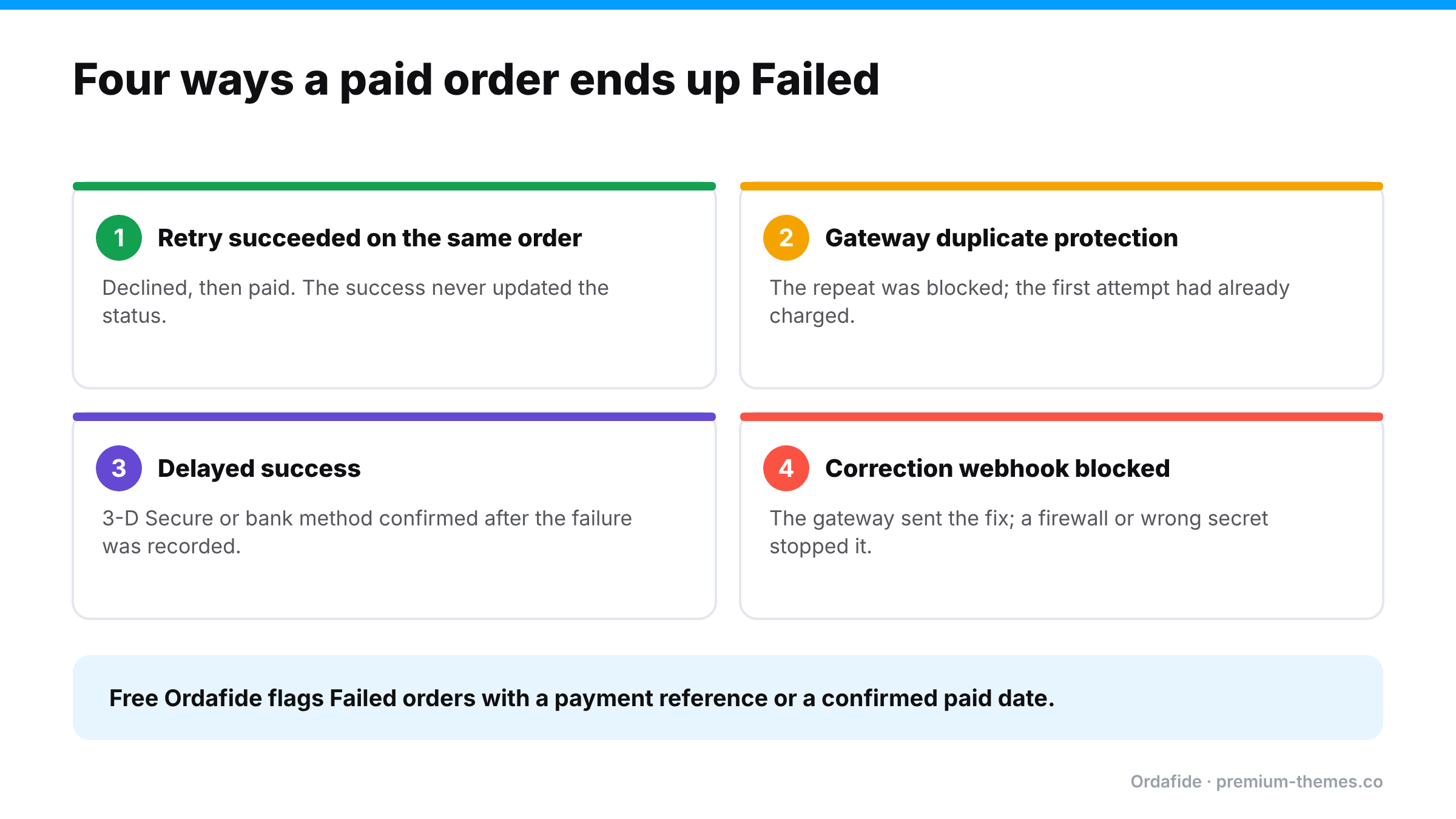
Four ways a paid WooCommerce order is recorded as Failed: a retry succeeded on the same order without updating status; gateway duplicate protection blocked a repeat after the first attempt charged; a delayed success arrived after the failure; or the correcting webhook was blocked. Ordafide flags Failed orders with a payment reference or paid date.

Here’s the problem. Failed is what WooCommerce believes happened. Sometimes the gateway disagrees.

Path 1: The customer retried and the second attempt succeeded on the same order

The first attempt is declined, so the order is marked Failed. The customer fixes their card details and pays successfully. If the success is recorded against the same order but the status update doesn’t complete (a webhook failure or plugin bug), the order stays Failed even though it now carries a successful payment.

Path 2: The gateway’s duplicate protection blocked a request that had already succeeded

A web agency documented a case where the gateway (NMI) rejected a second submission of a transaction as a duplicate. The first submission had actually succeeded. The customer saw an error, WooCommerce marked the order Failed, and the card was charged anyway. The gateway’s own log showed “Duplicate transaction”.

Path 3: A delayed success arrived after the failure

Some payment methods report a failure or timeout first and a success later (3-D Secure challenges that complete late, bank-based methods, wallets). If the later success never reaches WooCommerce, the order stays Failed.

Path 4: The webhook that would have corrected it was blocked

Even when the gateway does send the correction, a firewall, security plugin or wrong webhook secret can stop it from arriving. (See is your firewall blocking payments?.)

In every path, the customer has paid, and your store has no intention of shipping anything, because nobody works the Failed list.

How to triage a Failed order in two minutes

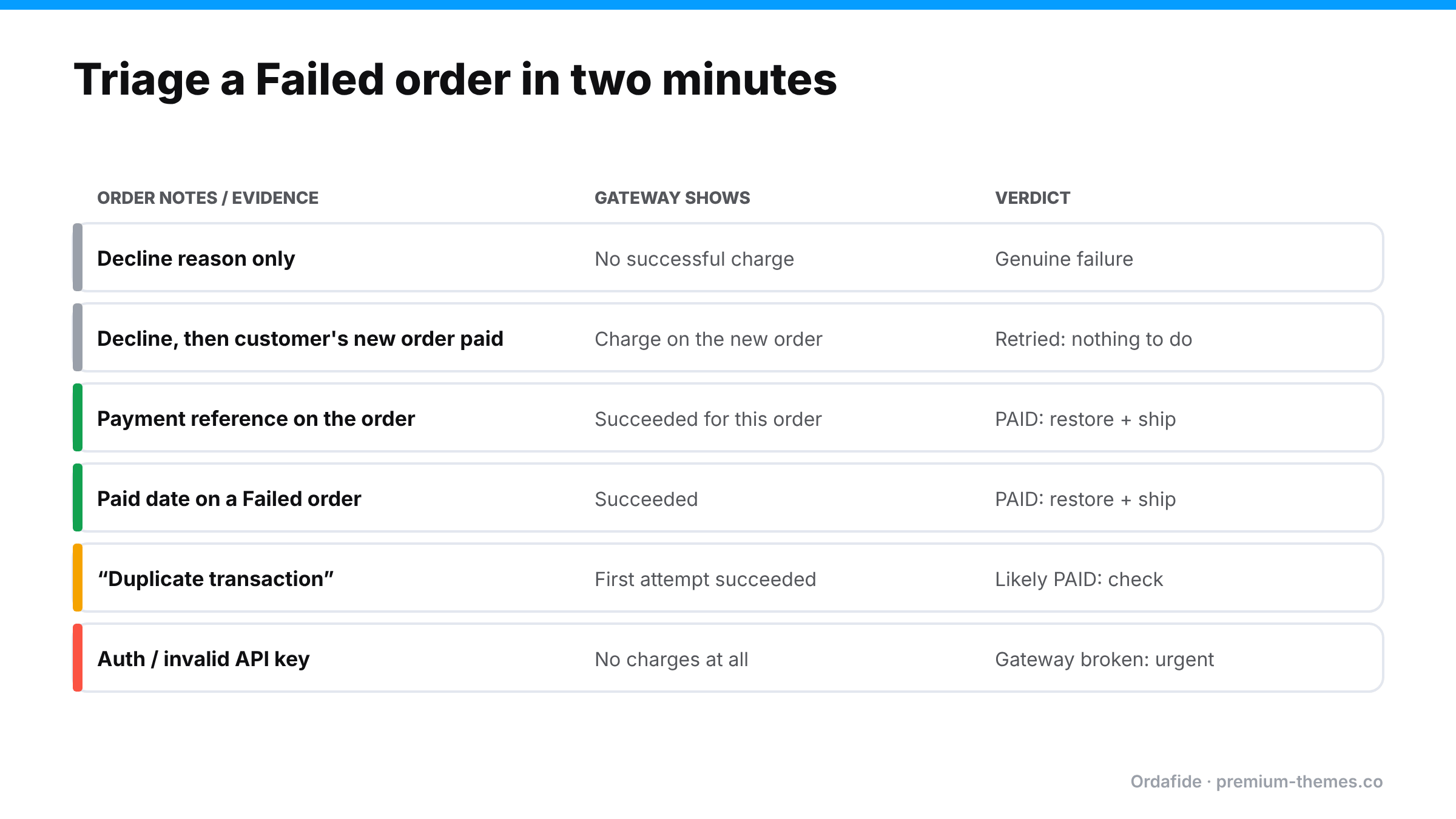
Triage table for WooCommerce Failed orders: a decline with no charge is a genuine failure; a decline followed by a paid new order needs nothing; a payment reference or paid date with a succeeded charge means the order was paid and should be restored; a duplicate transaction note likely means paid; an authentication or API key error means the gateway is broken.

Open the order and read it like evidence.

  1. Read the order notes from the bottom up. Gateways write what happened: “Card declined (insufficient funds)”, “3-D Secure authentication failed”, “Payment intent succeeded”. Pay attention to the last gateway note, not the first.
  2. Look for a transaction or payment reference. Many gateways write a reference (for example a Stripe Payment Intent ID) to the order. A reference on its own doesn’t prove payment, but it tells you exactly what to look up.
  3. Look for a paid date. If WooCommerce recorded a date paid on a Failed order, something is badly out of step: WooCommerce itself once believed the payment succeeded.
  4. Check the gateway. Search the reference or the customer’s email in your gateway dashboard. Is there a succeeded payment for this amount?
  5. Check for a second order. The customer may have given up and placed a new order that succeeded. Then the Failed order is just history, and nothing needs doing.
What you find What it means What to do
Decline note, no successful payment at the gateway Genuine failure Nothing, or a friendly “need help?” email
Decline note, but a later order from the same customer succeeded Customer retried on a new order Nothing
Gateway shows a succeeded payment for this order Paid but recorded as Failed Move to Processing, add a note, ship, apologize
Paid date recorded on a Failed order Paid but recorded as Failed Verify in gateway, then as above
“Duplicate transaction” note Gateway blocked a repeat. The first may have succeeded Check the gateway for the original charge
Authentication or API key error Your gateway connection is broken Fix now: every customer is failing (guide)

A worked example: five Failed orders on a Monday

Here’s what a typical weekend’s Failed list might contain, and how each one resolves.

#8812, $64, note: “Card declined (insufficient funds)”. No payment in the gateway. Ten minutes later the same customer placed #8815, which succeeded. Nothing to do. The customer retried on a new order.

#8820, $129, note: “3-D Secure authentication failed”, then nothing. The gateway shows a succeeded payment for the same Payment Intent four minutes later. The customer completed the bank challenge on a second attempt, but the success never reached the order. Paid but recorded as Failed. Move to Processing, ship, apologize.

#8827, $38, note: “Duplicate transaction”. The gateway shows one successful charge, from the first submission. The customer saw an error on the second. Paid. Restore and ship, and look at why checkout is slow enough for customers to resubmit.

#8831, $210, note: “Invalid API Key provided”. No charge at the gateway. Neither were there any successful orders after 02:10 on Sunday. Your gateway connection broke. This is the urgent one: every customer since 02:10 failed. (Gateway stopped working)

#8836, $19, random name, mismatched address, “card declined”. One of 40 similar orders between 03:00 and 04:00 for your cheapest product. Card testing. (Card testing guide)

Five Failed orders with five different explanations, two of which were paid. Without opening each one, all five look identical in the list.

Telling customers about genuine declines

For genuine declines, a short, friendly follow-up recovers real sales, especially for higher-value carts:

“Hi Sam, it looks like your payment for order #8812 didn’t go through. That’s usually a temporary card issue. If you’d still like your order, you can pay here: [link]. If you’ve already ordered again, please ignore this.”

Keep it helpful, not accusatory, and never send it before checking that the customer hasn’t already paid on another order.

When Failed orders spike

A handful of Failed orders a week is normal. A sudden change is a signal:

  • A spike of Failed orders on cheap products from random names: almost certainly card testing. (Card testing guide)
  • Every order failing with the same authentication error: your API keys expired, were rotated, or the account was disconnected.
  • Failed orders concentrated on one payment method or device: a compatibility problem after an update.
  • No Failed orders and no successful orders: not a payment problem at all. Checkout itself is broken. (Sales suddenly dropped?)

What happens to stock

Stock behaviour for Failed orders has changed across WooCommerce versions. WooCommerce’s troubleshooting documentation notes that from WooCommerce 11.0, moving an order to Failed returns stock only if stock had previously been reduced for that order, and an immediate decline leaves inventory unchanged. If you restore a Failed order to Processing because it was actually paid, check stock afterwards, especially on older versions or with inventory plugins.

Fixing a paid order that’s stuck on Failed

  1. Verify the payment in the gateway: status succeeded, amount and currency correct.
  2. Change the order to Processing and add a private note with the payment ID and how you verified it.
  3. Check stock for the items.
  4. Send the customer their confirmation (Order actions → Email invoice / order details to customer) and a short apology. They saw an error and were charged, so they’re worried.
  5. Look for a duplicate order in case the customer also paid a second time.
  6. Find the cause (webhook, duplicate protection, delayed method) so it doesn’t keep happening.

How Ordafide finds paid orders hiding in the Failed list

Nobody reads every Failed order, and that’s the point: the paid ones look exactly like the rest.

Ordafide Order Integrity for WooCommerce (free) scans your recent orders and flags the ones that don’t add up:

  • Stuck payment: orders on Pending payment or Failed that carry a gateway payment reference, the trace a gateway leaves when money moved.
  • Paid but cancelled: orders with a confirmed payment date sitting in Cancelled or Failed, with nothing refunded.
  • Duplicate charge: the same customer charged twice for an identical basket within minutes, common after a confusing failure.

Findings are sorted by money at risk, with the evidence laid out and what to check in your gateway before touching anything. When WooCommerce itself recorded a confirmed payment date, Ordafide can restore the order to Processing in one click. The change is logged and can be undone. Ordafide never captures, refunds or voids anything, and it sends nothing to a third party.

Ordafide Pro goes one step further with read-only gateway reconciliation (Stripe, PayPal, Square, Mollie, Razorpay). It compares what the gateway actually collected against your orders and flags money with no order, paid orders with no payment and amount disagreements, so a Failed order with a successful charge behind it can’t hide. Pro’s order volume anomaly detection also flags sudden spikes, the typical shape of a card testing attack, and its alerts reach Slack, SMS, email or a webhook.

A simple Failed-order routine

  • Daily: glance at the Failed count. Is it normal?
  • Weekly: review Ordafide’s findings (or the weekly summary email) for stuck and paid-but-failed orders.
  • On any spike: check for card testing, API key errors, or a broken payment method.
  • Optionally: email customers with genuine declines a short “having trouble paying?” note. It recovers real sales.

Reducing genuine failures

Not every Failed order is a hidden payment, and the genuine ones are worth reducing too:

  • Show clear error messages. A shopper who understands “your bank asked for extra verification” tries again. One who sees “error” leaves.
  • Offer more than one payment method. If a card fails, a wallet or PayPal often works.
  • Make checkout fast, so customers don’t resubmit and trigger duplicate protection.
  • Keep gateway and WooCommerce plugins updated. 3-D Secure and wallet handling improves over time.
  • Watch for patterns. Failures concentrated on one card brand, country or device usually have a fixable cause.

Refunded Orders Still Getting Shipped: Fixing WooCommerce Refund Status Mismatches

Refunds feel like the simple part of running a store. A customer asks for their money back, you click a button, done.

Except WooCommerce stores a refund in three places that are supposed to agree: the refund record on the order, the order status, and the payment gateway. When they disagree, odd and expensive things happen:

  • An order is fully refunded but still sits in Processing, so your warehouse picks and ships it. The customer gets the goods and their money.
  • An order is marked Refunded but no refund was ever issued. The customer never gets their money, and they file a dispute.
  • A refund is made in PayPal or Stripe, but WooCommerce still shows the order as paid. Revenue, stock and reports are all wrong.

These cases come up again and again on the WordPress.org support forums. This guide explains each mismatch, why it happens, how to find the ones already in your store, and how to make refunds reliable.

How WooCommerce refunds are supposed to work

When you refund from the order screen, WooCommerce:

  1. Creates a refund record attached to the order (amount, items, reason, who did it).
  2. If you chose Refund via [gateway], it asks the gateway to send the money back. If you chose Refund manually, it only records the refund. You’re saying the money went back some other way.
  3. If the order is now fully refunded, it changes the status to Refunded and sends the customer a refund email.
  4. If you ticked Restock refunded items, it increases stock.

For a partial refund, step 3 doesn’t happen. The order keeps its existing status. That’s by design, and it confuses a lot of people.

The four mismatches

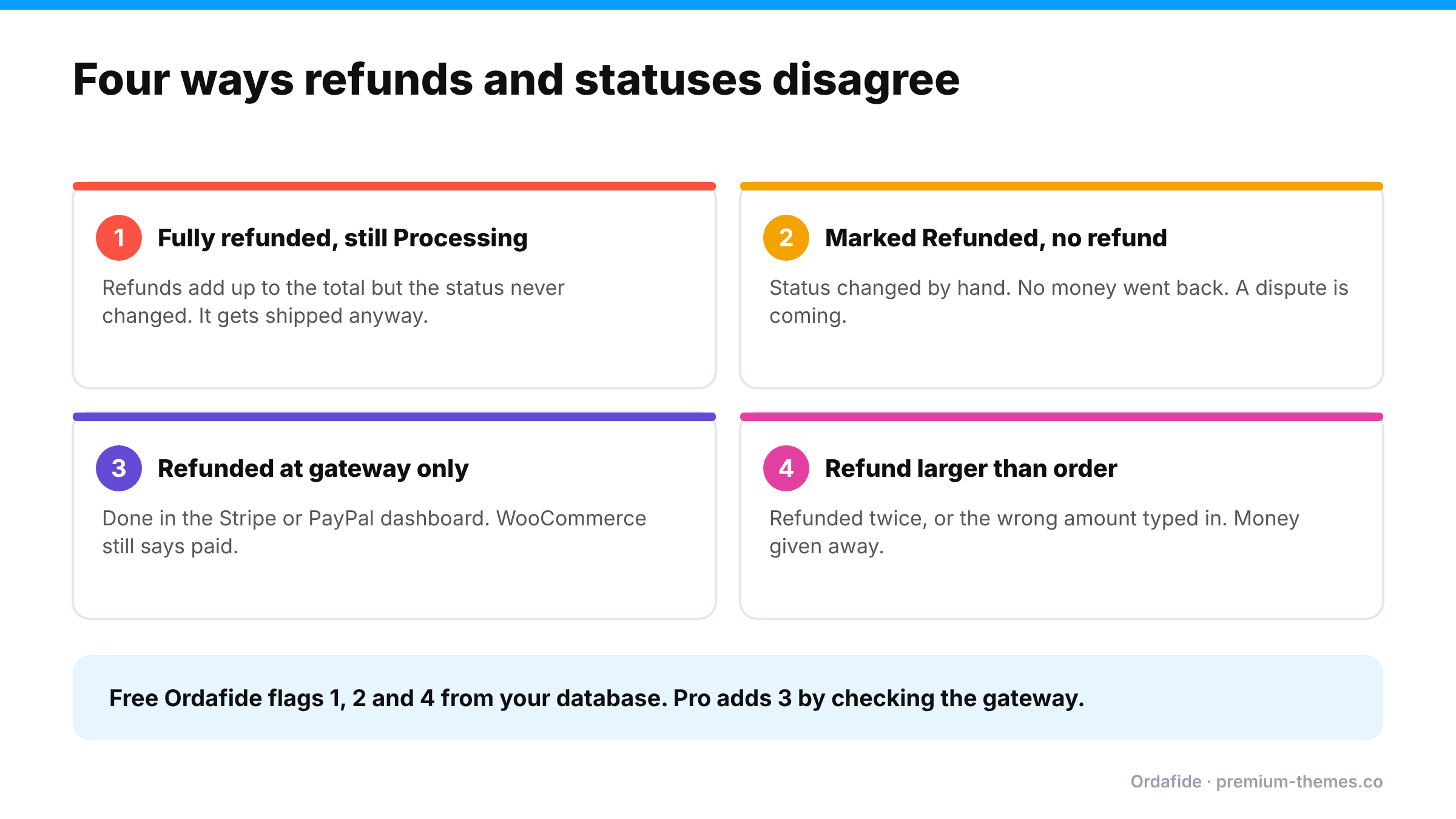
Four refund mismatches: fully refunded but still Processing, so it gets shipped; marked Refunded with no refund issued; refunded at the gateway only, so WooCommerce still shows paid; refund larger than the order. Free Ordafide flags the first, second and fourth; Pro adds gateway-only refunds.

Mismatch 1: Fully refunded, still Processing

What happens: the refund records add up to the full order total, but the status never changed. Because your team works from the Processing list, the order gets shipped.

Why:

  • The refund was recorded in several partial steps, and the final step didn’t trigger the status change.
  • A plugin conflict or customization interfered with the status update.
  • The refund was made at the gateway, the gateway plugin recorded it via webhook, but the status update failed.

One WordPress.org thread describes exactly this with the WooCommerce PayPal gateway: refunding sent the customer refund emails and reversed the charge, but the order stayed in Processing. Changing the status manually then sent a second refund email. The issue disappeared after later updates, but the owner had no way of knowing which past orders were affected.

Cost: the full value of the goods, plus shipping, plus the refund.

Mismatch 2: Marked Refunded, but no refund exists

What happens: someone changed the status to Refunded from the status dropdown, intending to refund, but never actually created a refund. Or they did it manually expecting the gateway to act.

Why: status and refund are separate actions. Changing the dropdown on its own doesn’t tell your gateway to send money (behaviour can vary by gateway plugin, so never rely on it).

Cost: a customer who believes they were refunded, or was promised one, and wasn’t. That’s a near-guaranteed chargeback and a lost customer.

Mismatch 3: Refunded at the gateway, not in WooCommerce

What happens: a team member refunds in the Stripe or PayPal dashboard because it’s quicker. WooCommerce never hears about it, or hears but fails to record it.

Why: some gateway plugins import dashboard refunds via webhooks, some don’t, and webhooks fail (see orders stuck on pending payment for why).

Cost: revenue overstated; stock that came back never restocked; reports and tax figures wrong; possibly the order still in Processing (back to mismatch 1).

Mismatch 4: Refund larger than the order

What happens: refunds on one order exceed what was paid. This can come from refunding twice (once at the gateway, once in WooCommerce), or from a manual refund entered with the wrong amount.

Cost: money you didn’t need to give away, and a messy reconciliation.

The partial refund trap

Partial refunds deserve their own warning. WooCommerce support confirmed in a WordPress.org thread that:

  • a partial refund doesn’t change the order status. A partially refunded On hold order stays On hold;
  • for manual refunds, setting the status to Refunded refunds the entire order, which can trigger a second refund email or a larger refund than intended.

The thread’s suggested workaround was a custom “Partially refunded” status via an order-status plugin. Whatever you choose, make sure your team knows that status alone doesn’t tell you whether an order has been refunded. Read the refund lines on the order.

Why it matters beyond the single order

It’s tempting to treat each mismatch as a one-off customer-service problem. But refund records feed several other parts of the business:

  • Revenue reports. WooCommerce Analytics subtracts recorded refunds. Missing ones overstate revenue; duplicated ones understate it.
  • Tax. Tax collected and tax refunded are reported from order and refund records. If a refund isn’t recorded, you may report and remit tax on a sale you reversed.
  • Stock. Restocking happens when refunds are recorded with Restock refunded items. A refund made only at the gateway never restocks, so products show out of stock when they’re on your shelf.
  • Customer history. Support teams look at an order and see “paid” or “refunded”. If that’s wrong, they give the customer wrong answers.
  • Disputes. If a customer disputes a charge, your evidence comes from the order record. A missing or wrong refund record weakens your case.

So a mismatch costs more than the one order. It quietly distorts the numbers you run the business on.

Finding mismatches already in your store

Manually

  1. Filter WooCommerce → Orders by Processing and open orders older than your usual fulfilment time. Look for refund lines (shown in red under the order items).
  2. Filter by Refunded and spot-check that each one actually has refund records totalling the order amount.
  3. Export refunds from your gateway for the last 30–90 days and check each one appears on the matching WooCommerce order.
  4. Look for orders where the refunded total exceeds the order total.

This is slow, but doable once. The trouble is it needs repeating, because mismatches keep happening as long as people, plugins and webhooks are involved.

Automatically with Ordafide

Ordafide Order Integrity for WooCommerce is free and runs a Refund mismatch check on your recent orders that flags:

– orders marked Refunded with no refund record (mismatch 2)
– refunds larger than the order (mismatch 4)
– fully refunded orders still marked Processing (mismatch 1), the ones about to be shipped

Each finding explains why it matters, shows the evidence, and tells you what to check before changing anything. Findings are sorted by money at risk, and you can ignore ones you’ve reviewed. Everything runs on your own server, and the plugin never refunds, captures or voids anything.

Mismatch 3, refunds that only exist at the gateway, can’t be seen from inside WooCommerce. Ordafide Pro reconciles with Stripe, PayPal, Square, Mollie and Razorpay using read-only keys and flags refunds missing in WooCommerce, along with money with no order, paid orders with no payment and amount disagreements.

Fixing each mismatch

Fully refunded, still Processing: stop fulfilment immediately. Confirm the refund at the gateway, then change the status to Refunded. If the refund was already completed, choose the status change carefully so you don’t trigger a second refund. Add a note.

Marked Refunded, no refund: check the gateway. If no money went back, issue the refund now from the order screen (Refund via [gateway]) and apologize to the customer. If the money did go back outside WooCommerce, record it with Refund manually so the books agree.

Refunded at gateway only: record it in WooCommerce using Refund manually (not via gateway, or you’ll refund twice), tick Restock refunded items if goods came back, and note the gateway refund ID.

Over-refund: check the gateway for what was actually returned. If the excess was real money, decide whether to recover it from the customer. If it was a recording error, adjust and note it.

A worked example: one week, three mismatches

To make this concrete, here’s how mismatches tend to appear on a real store over a single week.

Monday. A customer cancels a $78 order before it ships. A team member, in a hurry, opens Stripe and refunds it there. The Stripe plugin’s webhook is being blocked by a recently installed security plugin, so WooCommerce never records the refund. The order stays in Processing.

Wednesday. The warehouse picks the Processing list, including that $78 order, and ships it. The customer now has their money and the goods. (Mismatch 1 and 3 at once.)

Thursday. A different customer emails asking for a refund on a damaged item. A new team member changes the order status to Refunded from the dropdown, assuming that sends the money. It doesn’t with this gateway. The customer waits. (Mismatch 2.)

The following week. The second customer, hearing nothing, files a dispute with their bank. Meanwhile the first team member notices the Monday order in the Stripe dashboard, realizes it wasn’t recorded, and, to “fix it”, clicks Refund via Stripe on the WooCommerce order. Stripe rejects it because the charge is already refunded. Had the first refund been partial, the second could have gone through and pushed the total refunded past what the customer paid. (A near-miss for mismatch 4.)

Three people, three reasonable shortcuts, a shipped order, a dispute and a reconciliation mess. None of it was visible on the orders screen. All of it was findable by comparing refund records, statuses and the gateway.

A refund policy for your team

Paste this into your team handbook and adapt it:

How we refund

  1. All refunds are issued from the WooCommerce order screen using Refund via [gateway]. Never from the Stripe or PayPal dashboard.
  2. Never change an order’s status to Refunded to “do” a refund. Create the refund; the status follows.
  3. For partial refunds, select the items and quantities being refunded, and tick Restock refunded items only if the goods are back and sellable.
  4. If money was returned outside WooCommerce (bank transfer, gateway dashboard), record it with Refund manually and note the reference.
  5. Before shipping anything that’s been in Processing more than two days, check it has no refund lines.
  6. Return-related refunds go through our returns system, not ad hoc.

Making refunds reliable

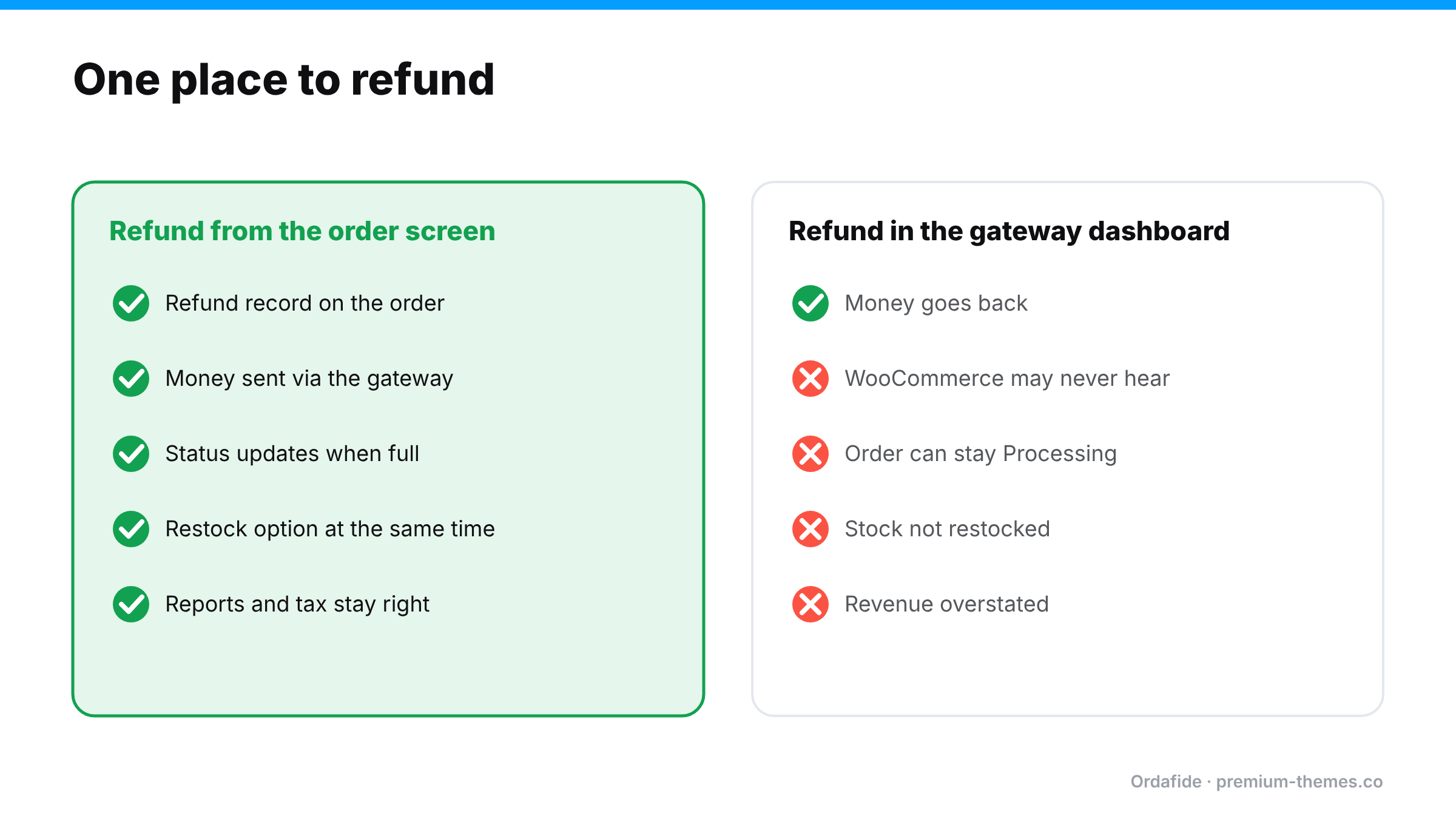
Comparison. Refunding from the WooCommerce order screen creates the refund record, sends money via the gateway, updates the status, offers restocking and keeps reports right. Refunding in the gateway dashboard returns the money, but WooCommerce may never hear, the order can stay Processing, stock isn't restocked and revenue is overstated.

  1. One place to refund. Make it a rule: refunds are issued from the WooCommerce order screen, never the gateway dashboard. The order screen talks to the gateway; the dashboard often doesn’t talk back.
  2. Never use the status dropdown to refund. Status follows refunds, not the other way round.
  3. Check refund lines before shipping. Add “no refund lines” to your packing checklist for orders that have been in Processing a while.
  4. Use a returns workflow for return-related refunds. If refunds come from product returns, a structured returns tool that creates the refund from the return record prevents double refunds. Our sister plugin Recirco does this.
  5. Scan regularly. A weekly Ordafide scan (or its weekly summary email) catches the mismatches that slip through anyway.

WooCommerce Orders Stuck On Hold: Authorized vs Captured Payments Explained

On hold is the most misunderstood order status in WooCommerce.

Some store owners see it and assume the payment failed. Others assume the money is safely in the bank and ship the order. Both can be wrong. And because On hold orders don’t show up in the Processing queue that most teams work from, they’re easy to forget entirely, until a customer asks where their parcel is or an accountant asks where the money went.

At the centre of most On hold confusion is one concept that WooCommerce merchants rarely get explained properly: the difference between a payment being authorized and a payment being captured.

This guide explains what On hold actually means, the five reasons orders end up there, how to tell which one you’re dealing with, and how to stop orders (and money) falling through the gap.

What “On hold” really means

WooCommerce’s own documentation describes On hold as an order awaiting payment confirmation: stock has been reduced, but you need to confirm payment before fulfilling. It’s a waiting room, not a verdict.

Compare it with the neighbouring statuses:

Status What it means Should you ship?
Pending payment Order created, no payment received yet No
On hold Awaiting payment confirmation; stock reduced Not until you’ve confirmed payment
Processing Payment received; ready to fulfil Yes
Completed Fulfilled Already done
Failed Payment failed or was declined No

The danger is in that middle row. An On hold order looks like a real sale, because stock has gone down and the order has items, an address and a total, but the money may not be yours yet. Or ever.

Authorized vs captured: the five-minute explanation

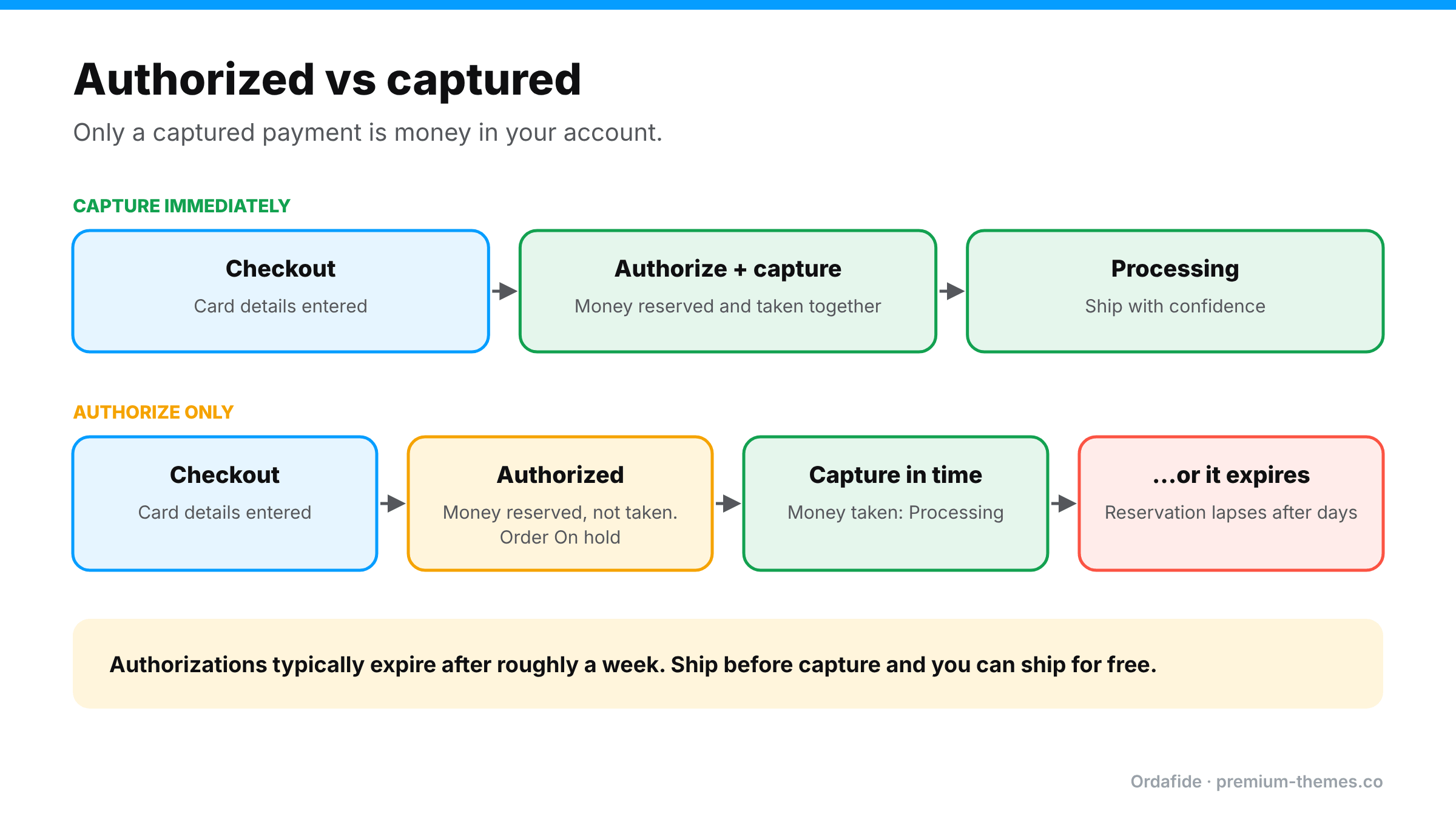
Two flows. Capture immediately: checkout, authorize and capture together, order goes to Processing. Authorize only: checkout, money reserved and order On hold, then either captured in time and moved to Processing, or the authorization expires after days. Shipping before capture risks shipping for free.

Card payments happen in two steps:

  1. Authorization. The customer’s bank confirms the card is valid and has enough funds, and reserves the amount. Nothing has moved. The customer sees a pending charge.
  2. Capture. You tell the gateway to actually take the reserved money. Now it moves toward your account.

Most stores capture immediately: both steps happen at checkout, and nobody thinks about it. But many gateways let you authorize only and capture later. That’s useful for made-to-order goods, pre-orders or stores that check stock before charging.

The catch: authorizations expire. Card networks typically hold an authorization for roughly a week (it varies by card type, network and gateway). If you don’t capture in time, the reservation lapses and the money is released back to the customer. You may already have shipped.

WooCommerce’s troubleshooting documentation calls this out directly: if your gateway only authorizes, funds aren’t transferred, and you need to either enable authorize-and-capture in the gateway settings or capture the charge manually.

The five reasons orders get stuck On hold

1. You chose authorize-only (and forgot to capture)

Many gateway plugins, including the WooCommerce Stripe and PayPal Payments plugins, offer a setting to capture charges immediately or only authorize them. With authorize-only, the order typically sits On hold until you capture, often by changing the order to Processing or Completed or using a capture action, depending on the plugin.

Symptom: order notes mention the charge was authorized rather than completed or captured.

2. An offline payment method

Direct bank transfer (BACS), cheque and cash on delivery orders go On hold by design. WooCommerce can’t know when the money arrives, so it waits for you.

Symptom: payment method is BACS or cheque. This is normal. The risk is only that nobody checks the bank.

3. A delayed-notification payment method

Some methods, such as SEPA Direct Debit and certain bank-based methods, take days to confirm. WooCommerce’s documentation notes these may sit On hold temporarily until the gateway confirms.

Symptom: payment method is SEPA or similar; order notes show the payment as initiated or processing.

4. The gateway’s confirmation didn’t match what the plugin expected

A WordPress.org support thread describes a store using PayPal Powered by Braintree where card payments were authorized and settled at Braintree but orders stayed On hold. The plugin checked for one specific settlement status, while Braintree sometimes reported a different, still-valid one for up to 24 hours. The money was fine. The store’s records weren’t.

Symptom: gateway dashboard shows the payment as settled or captured, but the order never moved.

5. A risk or review hold

Gateways and fraud tools can hold payments for review (PayPal “pending” reasons, fraud screening, unverified accounts). The order waits until the review finishes.

Symptom: order notes or the gateway show a review, pending reason or risk flag.

How to diagnose an On hold order in two minutes

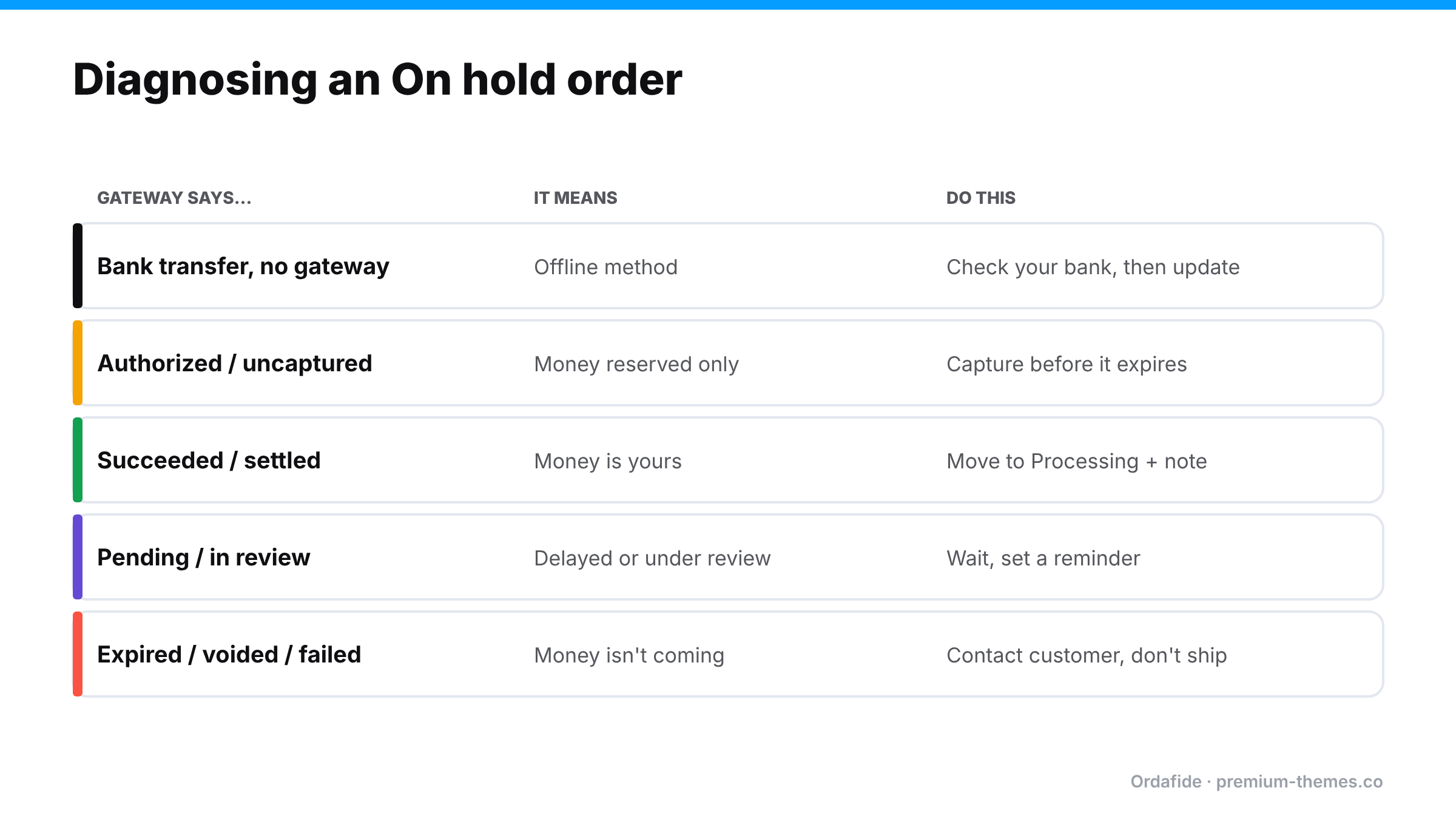
Table: bank transfer means check your bank then update; authorized or uncaptured means capture before it expires; succeeded or settled means move to Processing with a note; pending or in review means wait; expired, voided or failed means contact the customer and don't ship.

Open the order and work through this:

  1. 1. Check the payment method. BACS, cheque or COD? It’s case 2: check your bank and update manually.
  2. 2. Read the order notes. Look for the words authorized, captured, pending, review or a gateway status.
  3. 3. Find the transaction ID and open it in the gateway dashboard. What does the gateway say?
    • Authorized / uncaptured: case 1. Capture it (if you intend to fulfil) before the authorization expires.
    • Succeeded / captured / settled: case 4. Money’s in. Move the order to Processing and add a note.
    • Pending / in review: case 3 or 5. Wait, but set a reminder.
    • Expired / voided / failed: the money isn’t coming. Contact the customer before shipping anything.
  4. Check the order date. An authorization more than a few days old is at risk. Prioritize it.

The costly scenario: “paid” orders with no captured money

Here’s where it really hurts. Imagine your team moves On hold orders to Processing in bulk every morning to get them into the picking queue, perhaps because “On hold” orders always turn out fine.

If even one of those was an authorization that later expired or was never captured, you’ve shipped goods for free, and nothing in WooCommerce will ever tell you. The order says Processing, then Completed. It has a transaction ID. It looks perfect. Only the gateway knows no money was collected.

This is one of the cases where WooCommerce’s records and reality disagree silently. It’s also why “just check the order status” isn’t a reliable control.

A worked example: Monday morning’s On hold list

Here’s what a typical On hold list might look like on a small store after a weekend, and how to handle each one.

Order #4102: Direct bank transfer, $89, placed Saturday.
The customer chose bank transfer. You check the bank account: no payment yet. This is normal. Leave it On hold, and if nothing arrives within your stated payment window (say five days), send a reminder and then cancel to release the stock.

Order #4108: Card via Stripe, $240, placed Friday night, note says “authorized”.
Your Stripe plugin is set to authorize only, because you make items to order. Open the transaction in Stripe: it shows Uncaptured. If you’re starting production today, capture it now. Waiting until you ship next week risks the authorization expiring. If the item is out of stock and you won’t fulfil, cancel the authorization rather than letting it lapse, so the customer’s funds are released promptly.

Order #4111: PayPal, $56, placed Sunday, note says “pending: payment review”.
PayPal is reviewing the payment. Don’t ship. Check again later in the day. If PayPal completes it, the order should move forward on its own; if it doesn’t, compare the PayPal status and update by hand.

Order #4115: Card via another gateway, $132, placed Sunday, no useful note.
You open the gateway dashboard: the payment shows as settled. The money is yours. The plugin simply didn’t recognize the status it received. Move the order to Processing, add a note with the transaction ID, and check for a gateway plugin update.

Four orders, four different correct answers, and only one of them needed no action. That’s why On hold can’t be handled with a single rule like “promote everything each morning”.

Getting your capture settings right

Wherever your payment plugin’s settings live (usually WooCommerce → Settings → Payments → [gateway] → Manage), look for a setting along the lines of capture charge immediately, payment action: capture / authorize, or intent. Then:

– If you ship from stock: choose immediate capture. You don’t need authorize-only.
– If you make to order or sell pre-orders: authorize-only can make sense, but write down who captures, when, and what happens to authorizations older than a few days.
– If you’re not sure what’s configured: place a small real order and check the gateway. An uncaptured payment means you’re on authorize-only.

Changing this setting affects new orders only. Existing authorized orders still need capturing or cancelling individually.

Fixing On hold for good

Decide deliberately between immediate capture and authorize-only

Unless you have a real business reason to delay capture (made-to-order, stock verification, pre-orders), capture immediately. It removes an entire class of problems. If you do authorize-only, make capture part of a daily routine and make sure everyone knows authorizations expire.

Give On hold orders an owner

Add a daily check of the On hold filter in WooCommerce → Orders. Every order there should have an obvious reason (bank transfer awaiting payment, SEPA pending, authorized awaiting capture) and a next step.

Never bulk-promote On hold orders without checking the gateway

If you bulk-move orders to Processing, do it only after checking that each one’s payment is captured or confirmed. It’s tedious, which is exactly why it should be automated.

Keep gateway plugins current

Status-mapping issues like the Braintree example are typically fixed in plugin updates. Running old gateway plugins means running old bugs.

Reconcile against the gateway

The only way to catch “order says paid, gateway says no” is to compare the two. See how to reconcile WooCommerce orders with Stripe and PayPal.

How Ordafide helps

Ordafide Order Integrity for WooCommerce (free) scans your recent orders and raises plain-English findings sorted by money at risk. For the problems in this article it gives partial cover from your own database:

  • Its stuck payment and paid but cancelled checks flag orders where the gateway wrote a payment reference or WooCommerce recorded a confirmed payment date, but the status says otherwise, which helps when a valid payment never moved the order forward.
  • Its refund mismatch and order total checks catch other cases where an order’s status and its numbers disagree.

But an order that’s been promoted to Processing without the money ever being captured looks internally consistent. Only the gateway knows. That’s what Ordafide Pro adds: read-only reconciliation with Stripe, PayPal, Square, Mollie and Razorpay, which flags:

  • Paid orders with no payment: orders WooCommerce treats as paid where the gateway has no matching captured payment
  • Money with no order
  • Amount disagreements
  • Refunds missing in WooCommerce

With Pro’s alerts (Slack, SMS, email or signed webhook), a “shipped but never captured” order becomes a same-day notification rather than a hole your accountant finds next quarter. Ordafide never captures, refunds or voids anything itself; capturing stays a deliberate decision you make in the gateway or your payment plugin.

Daily On hold routine (5 minutes)

  1. Filter WooCommerce → Orders by On hold.
  2. For each BACS/cheque order: check the bank, then move to Processing or chase the customer.
  3. For each authorized order: capture if you’re ready to fulfil; flag anything older than a few days.
  4. For each delayed method order: leave it, but note how long it’s been waiting.
  5. For anything settled at the gateway but still On hold: move to Processing with a note, and look for a plugin update.
  6. Never mass-promote without checking.