A post on Reddit’s ecommerce communities captured a frustration a lot of store owners share. An apparel merchant, about two years in, noticed a small group of customers who kept buying, returning, and apparently wearing items before sending them back. Returns were auto-approved with no flags and no customer history, so the pattern only became obvious after it had cost real money. Their question: how do you spot repeat return abuse before approving the refund?
The replies were revealing. Some said ban them. Some said charge for returns. One commenter claimed that “90% of problems often come from about 2% of customers”. Others pushed back: frequent returns might mean the sizing is wrong, not that the customer is dishonest.
Both sides are right, and that’s the challenge. The NRF and Happy Returns estimated that 9% of all returns in 2025 were fraudulent (NRF, October 2025). That’s a real cost. But the other 91% are honest, and the same report found 71% of shoppers are less likely to buy again after a poor returns experience. Clamp down on everyone and you lose more good customers than you stop bad ones.
This guide covers the common types of return fraud and abuse, the signals that identify them, and how to set up WooCommerce so risky returns get a closer look while honest customers sail through.
The main types of return fraud and abuse
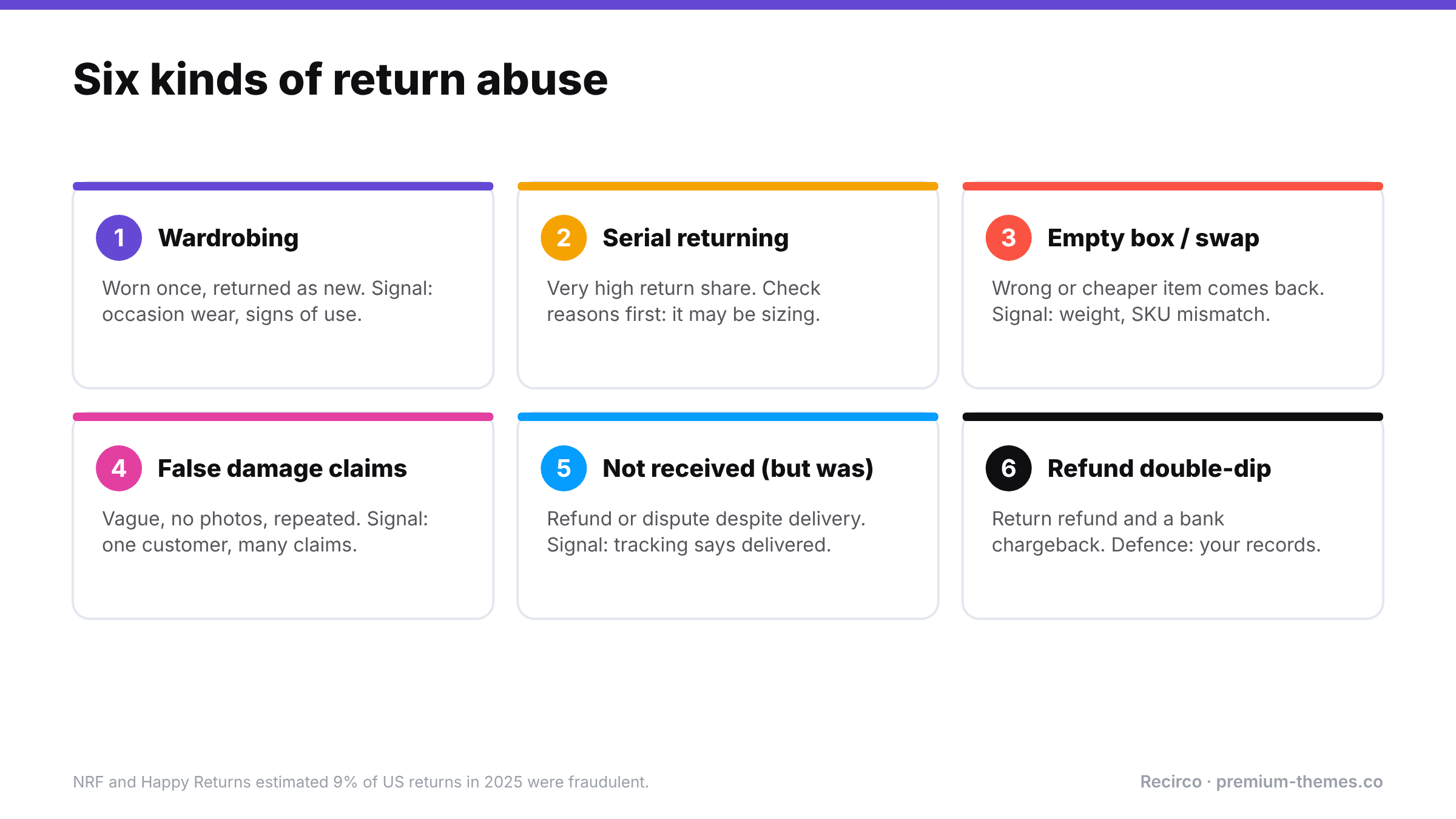
| Type | What happens | Typical signal |
|---|---|---|
| Wardrobing | Item bought, worn or used once (an event, a photo shoot), then returned | Fashion, occasion wear, cameras; returns just inside the window; signs of wear |
| Serial returning | A customer returns a very high share of what they buy | High return rate per customer over time |
| Empty box / wrong item returned | Box returned empty, or with a cheaper or counterfeit item | Weight mismatch; inspection finds wrong item |
| False damage claims | Item claimed damaged or defective when it wasn’t | Vague descriptions; no packaging photos; repeat claims |
| “Item not received” while receiving it | Customer claims non-delivery to get a refund, or disputes with their bank | Delivery confirmed; history of similar claims |
| Return outside the policy | Late returns, used items, excluded products, pushed through by persistence | Requests outside window; excluded categories |
| Refund double-dipping | Customer requests a return refund and files a chargeback | Dispute on an order already refunded |
Not all of these are “fraud” in a legal sense. Serial returning and late returns are often policy abuse, and sometimes not abuse at all. Your process should treat them differently.
Step 1: Separate honest-but-expensive from abusive
Before tightening anything, look at why your heavy returners return.
- If a customer returns lots of items with “Too small” / “Too large” reasons, your size guide may be the problem. Fix the product page and offer exchanges instead of refunds. (See reducing your return rate with reason data.)
- If they consistently return items after events or weekends, in visibly used condition, that’s wardrobing.
- If returns come with “Damaged” claims and no evidence, that needs scrutiny.
Return reasons and history turn a vague suspicion into a clear picture. Without them, you’re guessing, and guessing usually means treating everyone the same.
Three high returners, three different answers
Customer A has returned 6 of 9 orders this year. Every return reason is Too small, mostly on one brand of jeans. Items come back unworn with tags. Not abuse. That brand runs small. Add a sizing note to those product pages, offer an exchange, and Customer A will likely become a profitable regular.
Customer B has returned 5 of 7 orders, mostly dresses and occasion wear, each requested on a Monday or Tuesday, close to the end of the return window. Two arrived with makeup marks and creased fabric. Likely wardrobing. Hold their future returns for inspection, refund only after arrival, and enforce the condition rules in your policy.
Customer C has made three “arrived damaged” claims in two months on different products, each with a one-word description and no photos, while other customers ordering the same products report no damage. Suspicious. Require photos of the item and packaging for future claims, and hold them for review.
Three customers with high return rates, and only two of them are a problem. Reasons and history are what tell them apart.
Step 2: Make the policy do the work
Most abuse thrives on ambiguity: late returns that get approved because nobody checked the date, used items accepted because the policy didn’t say “unused”, gifts kept because nobody asked for them back. Tighten the policy text, then enforce it automatically so no one has to argue:
- Return window counted from delivery or completion, enforced by the system rather than staff.
- Condition rules: unworn, unwashed, tags attached, original packaging. Consider non-removable tags for occasion wear.
- Excluded categories: final sale, personalized, intimate apparel, opened hygiene products.
- Evidence for claims: photos required for damage and fault reasons.
- Consequences stated plainly: “Items returned used or incomplete may be refused or refunded partially.”
([Return policy template](/blog/woocommerce-return-policy/))
Step 3: Route by risk, not by rule-for-everyone
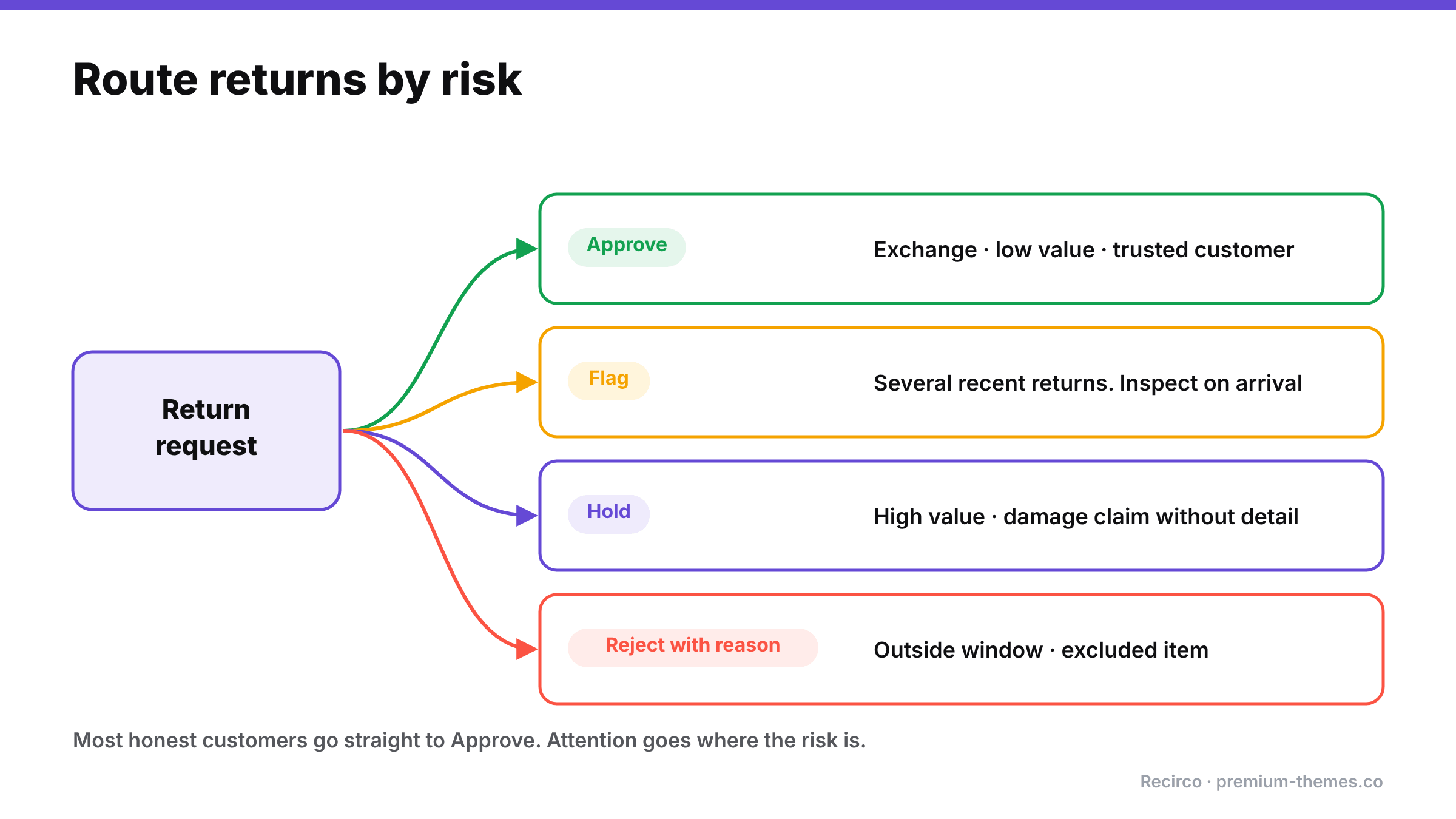
The best idea from that Reddit thread, and from others like it, was risk-based routing: automate the obvious cases, and send the rest to a human with context.
| Return | Route |
|---|---|
| Low value, trusted repeat customer, normal reason, inside window | Auto-approve |
| Exchange for a different size | Auto-approve (revenue kept, low risk) |
| High-value order | Hold for manual review |
| Customer with several recent returns | Flag for review |
| Damage claim without detail | Hold; request evidence |
| Outside window or excluded item | Reject with a clear reason (or flag if you allow exceptions) |
This keeps the experience fast for the large majority while focusing your attention where risk actually is.
Step 4: Inspect what comes back
For anything above a low-value threshold:
- Weigh parcels against expected weight.
- Check SKU, serial number and condition before refunding.
- Restock only after inspection. If you restock on approval, abuse gets into your sellable stock.
- Refund after arrival for higher-risk returns, not on approval.
A simple inspection checklist
Keep it next to wherever returns are unpacked:
- Match the return number to the parcel and the request.
- Check the item and SKU match what was ordered and requested.
- Check the serial number for warranty products.
- Check condition: tags attached, unworn, unwashed, no marks, odours or damage.
- Check completeness: accessories, parts, manuals, packaging.
- Photograph anything that fails inspection before you do anything else.
- Record the outcome on the return (accepted, partially accepted, refused) with a note.
- Restock only accepted items.
It takes a minute per parcel and gives you evidence if a customer disputes a refused or partial refund.
Step 5: Keep a record, and act on patterns
Every return should record the customer, items, reason, description, condition on arrival, decision and who made it. Patterns then become visible:
- Customers whose returns are repeatedly refused on inspection
- The same serial number appearing in more than one claim
- Damage claims that cluster on one customer rather than one carrier
For genuine, repeated abuse, many stores’ terms reserve the right to refuse future orders or returns. Use it sparingly, based on records rather than hunches.
When a refund becomes a chargeback
One form of abuse sits between returns and payments: the customer requests a return, gets refunded, and disputes the original charge with their bank. Without records, you can end up refunding twice. Your defence is documentation: the return record, the refund in WooCommerce, the gateway refund ID, and the customer emails. Respond to the dispute with that evidence promptly.
What not to do
- Don’t hide the return policy or make returns deliberately painful. You’ll lose honest customers at the checkout before any fraudster is deterred.
- Don’t treat every high returner as a fraudster. Check reasons first.
- Don’t refund before inspecting high-value returns.
- Don’t let staff judge exceptions differently. Inconsistency is what serial abusers exploit.
- Don’t refund in two places. Double refunds aren’t customer fraud, but they’re just as expensive. (See refund status mismatches.)
Setting it up in WooCommerce with Recirco
WooCommerce has no returns system, so out of the box there’s no window enforcement, no reasons, no history and no approval step. Recirco – Returns & Exchanges for WooCommerce adds them for free:
- Return window enforcement in days, measured from the order’s completed, paid or created date. Late requests simply can’t be submitted.
- Eligible order statuses and excluded products and categories, so final-sale and hygiene items are never offered as returnable.
- Per-unit eligibility, so the same unit can’t be returned twice.
- Reasons on every return, each optionally requiring an explanation, so damage claims arrive with detail.
- Approval queue with search, filters and bulk actions. Nothing is refunded until someone approves it (unless you enable auto-refund on completion).
- Restock timing: on arrival or on completion is the safe choice for abuse-prone categories.
- Activity log and notes on every return: an evidence trail if a customer later disputes the charge.
- Refunds from the return, designed to prevent duplicate refunds for the same return.
Recirco Pro adds the risk-routing layer:
- Conditional approval rules: a set of seven conditions and four actions (approve, reject with reason, flag, hold). The first matching rule wins, and the activity log names the deciding rule, so every automated decision is explainable. Auto-approve the routine, hold the risky. (Check the Recirco documentation for the exact conditions available and map your risk signals to them.)
- Photo uploads with claims (up to 5 photos, 5 MB each) and warranty serial-number registration, which deters false damage and warranty claims.
- Exchanges and store credit, which give honest “wrong size” returners a better path than a refund and reduce the incentive for refund abuse.
- Analytics: reasons ranked by count and value, most-returned products, value returned. That separates product problems from customer problems.
Note: the current version of Recirco requires customers to have an account to request a return. For abuse prevention that’s a benefit: every return is tied to a known customer and their history.
A balanced anti-abuse policy (template)
Fair returns
We want returns to be easy for our customers. To keep them that way:
- Returns must be requested within [30] days of delivery from My Account → Returns.
- Items must be unworn, unwashed and returned with all tags and packaging.
- [Final-sale, personalized and hygiene items] can’t be returned.
- Damage and fault claims need a short description and photos.
- We inspect every return. Items returned used, damaged by the customer or incomplete may be refused or partially refunded.
- We may decline future orders or returns where we see repeated misuse of this policy.
- This doesn’t affect your statutory rights.