
Most WooCommerce return policies have the same problem. The page says “Returns accepted within 30 days,” and then nothing in the store enforces it.
A customer asks to return something on day 47. Your team member doesn’t want an argument, so they approve it. Another customer returns a final-sale item because nothing stopped them from asking. The policy exists, but only on paper.
This guide covers what a good return policy includes, the legal minimums for the main Western markets, a free template you can adapt, and how to make WooCommerce enforce your policy automatically.
This article is general information, not legal advice. Consumer law varies by country and state, so check the rules for the markets you sell to.
Why your return policy affects sales, not just returns
Shoppers read return policies before they buy. Loop’s 2026 Returns Revenue Gap survey of 3,000 consumers in the US, UK and Australia found that 59% always or often check the returns policy before buying, and 58% have abandoned a purchase or walked away from a brand because of its return policy (Loop Returns, July 2026).
The NRF found 82% of consumers say free returns are a major purchase consideration (NRF, October 2025).
A clear policy isn’t just protection. It’s a conversion tool.
What every return policy should cover
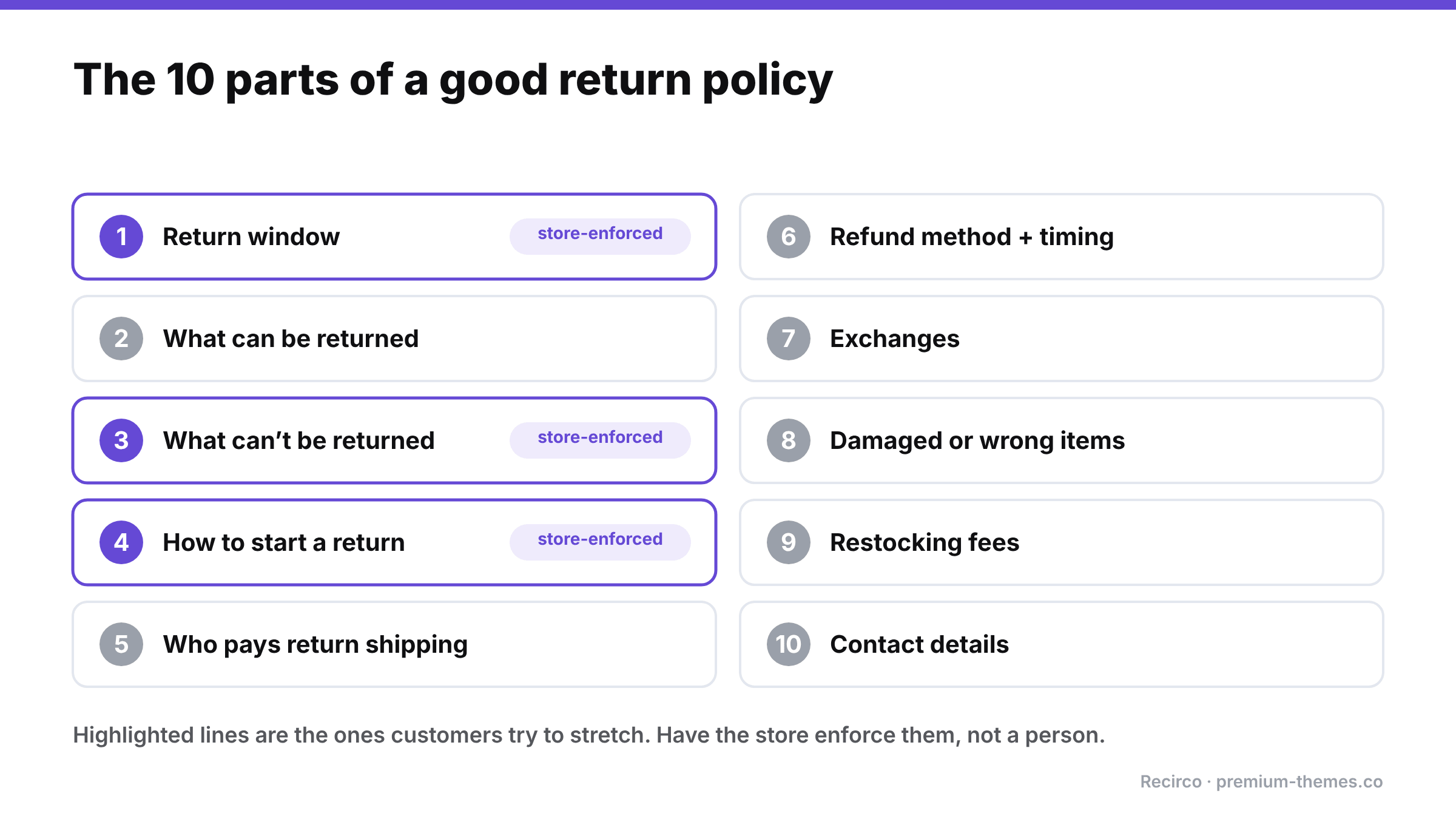
- The return window: how many days, and counted from when (order date, delivery date).
- What can be returned: condition requirements (unused, tags attached, original packaging).
- What can’t be returned: final sale, personalized, hygiene items, perishables, digital downloads.
- How to start a return: ideally “from your account,” not “email us.”
- Who pays return shipping, and whether a label is provided.
- Refund method and timing: original payment method, store credit, or exchange, and how long it takes after the item arrives.
- Exchanges: whether you offer them and how.
- Damaged or wrong items: a separate, faster process.
- Restocking fees, if any.
- Contact details for questions.
The legal minimums in key markets
European Union
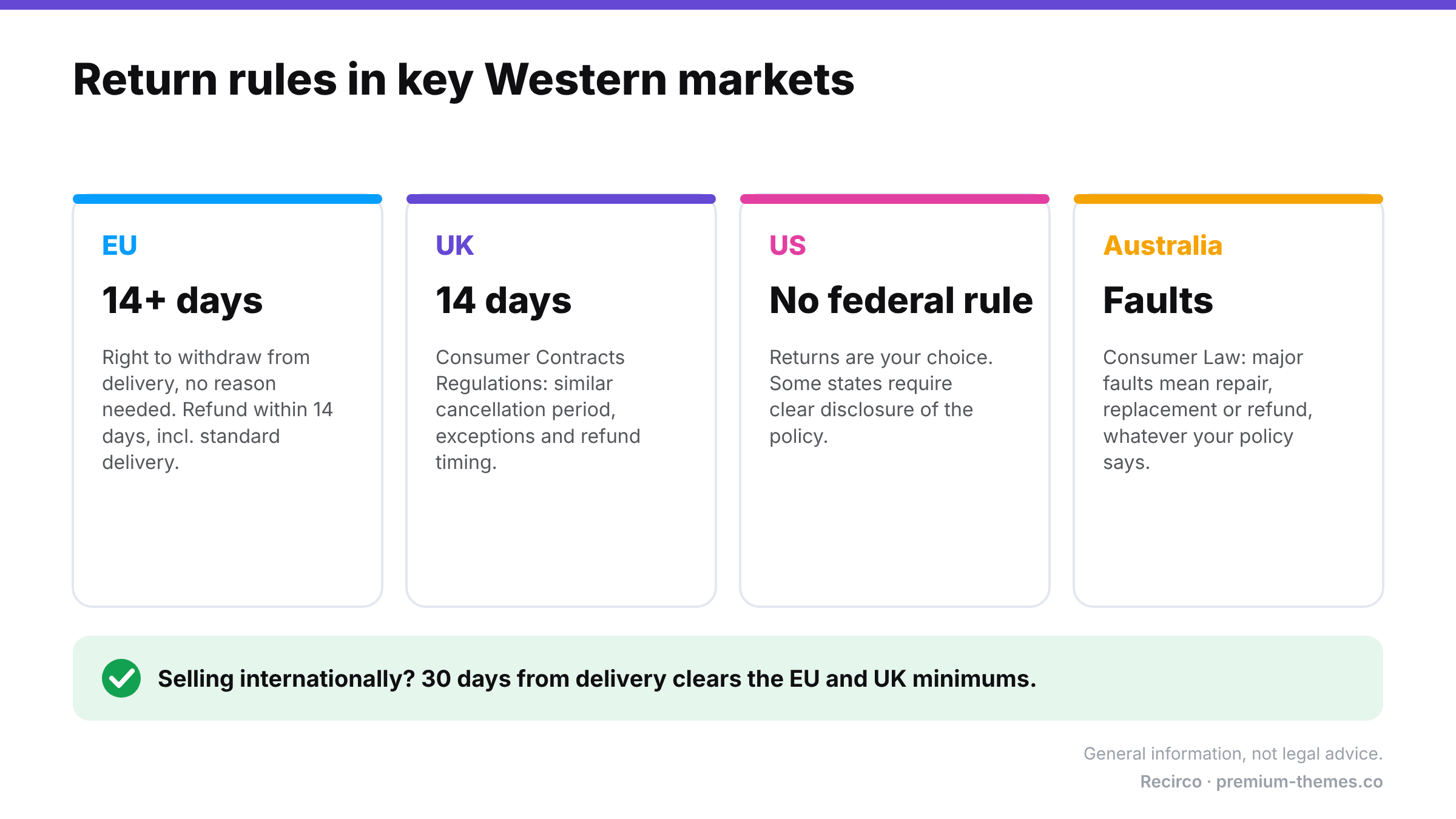
Under the EU Consumer Rights Directive, consumers buying online generally have at least 14 days from receiving the goods to withdraw from the purchase without giving a reason. Once they tell you, you generally have 14 days to refund, including the original standard delivery cost. You may withhold the refund until you receive the goods or proof they were sent back. There are exceptions, such as personalized goods, sealed hygiene products that were unsealed, and perishables. If you don’t inform customers of their right of withdrawal, the period can be extended significantly.
United Kingdom
The Consumer Contracts Regulations give a similar 14-day cancellation period for online purchases, with similar exceptions and refund timing.
United States
There’s no general federal law requiring retailers to accept returns. Some states have rules about disclosing your policy (especially if you don’t offer refunds). Whatever you choose, state it clearly and stick to it.
Australia
Australian Consumer Law gives customers rights to a repair, replacement or refund when goods have a major fault, regardless of your “change of mind” policy. Don’t write a policy that implies otherwise.
The practical takeaway: if you sell internationally, a 30-day window counted from delivery comfortably clears the EU and UK minimums and matches what many shoppers expect.
Free WooCommerce return policy template
Copy this into a page (e.g. Returns & Refunds), replace the bracketed parts, and link it from your footer, product pages and checkout.
—
Returns & Refunds
We want you to love what you ordered. If something isn’t right, you can return it within [30] days of delivery.
How to start a return
Log in to My Account → Returns, choose the order and items, and tell us why. You’ll get a return number (RMA) and our return address straight away. No need to email us.
What can be returned
Items must be unused, in their original condition and packaging, with tags attached.
What can’t be returned
[Final-sale items], [personalized items], [underwear and swimwear for hygiene reasons], [gift cards]. These are marked on the product page.
Return shipping
[Return shipping is free / Return shipping costs are deducted from your refund / We’ll email you a prepaid label once your return is approved.]
Refunds
Once your return arrives and is checked, we’ll refund your original payment method within [5] business days. Your bank may take a few more days to show it.
Exchanges and store credit
[Prefer a different size or colour? Choose an exchange when you request your return and we’ll send the replacement once your return is processed.] [Choose store credit and we’ll add a [10]% bonus.]
Damaged, faulty or wrong items
Please request a return within [7] days of delivery and select “Damaged or defective” or “Wrong item,” with a short description. We’ll make it right at no cost to you.
EU and UK customers
You have the right to cancel your order within 14 days of receiving it without giving a reason. This policy does not affect your statutory rights.
Questions? Contact us at [help@premium-themes.co].
—
Best practices that reduce friction (and abuse)
- Count from delivery, not order date. It’s fairer, and it’s how EU law counts.
- Make “how to start a return” self-service. Every email exchange costs you time and frustrates the customer.
- Ask for a reason on every return. It costs the customer two seconds and gives you the data to fix product pages and sizing.
- Require detail for some reasons only. “Damaged” needs a description. “Changed my mind” doesn’t.
- Offer exchanges and store credit alongside refunds. (See Exchanges vs refunds.)
- Be consistent. Inconsistent exceptions are what train customers to push.
How to enforce your policy in WooCommerce
Here’s the gap: WooCommerce has no concept of a return window or non-returnable products. Your policy page can say anything, but nothing in the store applies it.
The free Recirco – Returns & Exchanges for WooCommerce plugin turns your written policy into rules the store enforces:
| Policy line | How Recirco enforces it |
|---|---|
| “Within 30 days of delivery” | Return window in days, counted from the order’s completed, paid or created date |
| “Final sale items can’t be returned” | Excluded products and categories never appear as returnable |
| “Start your return in My Account” | A Returns tab in My Account with only eligible items shown |
| “Tell us why” | Configurable reasons, each optionally requiring an explanation |
| “You’ll get a return number” | Automatic RMA numbers with your own prefix |
| Policy text and return address | Shown to customers on the return status page |
Customers simply can’t submit a return outside the window or for an excluded item, so your team never has to say no by email. Late or borderline cases you want to allow can still be handled manually.
Recirco Pro goes further with conditional approval rules (seven conditions, four actions: approve, reject with reason, flag, or hold, with the first matching rule winning and the deciding rule named in the activity log). For example, you could auto-approve low-value returns from repeat customers and flag high-value ones for review.