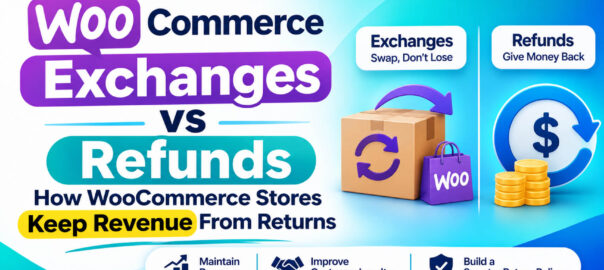
When a customer returns something, you have three ways to resolve it:
- Refund. The money goes back. The sale is gone.
- Exchange. They get a different size, colour or product. The sale stays.
- Store credit. The money stays with you, to be spent later.
Most WooCommerce stores default to option 1, because it’s the only one WooCommerce supports natively. That’s an expensive default.
This article looks at why exchanges and store credit matter, what the data says about shopper behaviour, and how to offer both in WooCommerce without building a manual process around them.
The scale of the problem
The National Retail Federation estimated US consumers would return $849.9 billion of merchandise in 2025, with 19.3% of online sales returned (NRF, October 2025).
You can’t stop all returns, and you shouldn’t try. Many happen because the customer genuinely needed a different size. But you can change how they end.
What shoppers actually want

Loop’s 2026 survey of 3,000 consumers and 600 retailers across the US, UK and Australia found (Loop Returns, July 2026):
- 75% of consumers prefer a full refund by default…
- …but 87% would consider an exchange if the experience were easy enough.
- The top factors in choosing an exchange were ease of processing (37%) and speed (35%).
- Incentives work: 39% said bonus store credit could steer them away from a refund, 36% a waived exchange fee, and 35% a speedy replacement.
- Across retailers surveyed, refunds made up 46% of returns processed, exchanges 29%, store credit 25%.
The takeaway: customers don’t insist on refunds because they hate exchanges. They default to refunds because exchanges are usually harder. Usually that means emailing, waiting for the return to arrive, then placing a new order themselves.
Why exchanges are worth so much
- You keep the revenue. The original sale stays on your books.
- You keep the customer. A shopper who gets the right size is far more likely to buy again than one who got a refund and moved on.
- The customer gets what they wanted. They wanted the product. It just wasn’t quite right.
- Variant swaps are low-risk. Same product, same price, different size or colour.
Why store credit is worth offering too
Not every return has an obvious replacement. Store credit lets the customer decide later, while the money stays with you.
- A small bonus changes behaviour. Offering, say, 10% extra as store credit versus a refund is a strong nudge, and costs you far less than losing the full sale.
- Expiry encourages use (check local laws on credit and gift card expiry before setting one).
- It brings customers back to your store to spend it, often spending more than the credit.
How WooCommerce handles exchanges and store credit today
Out of the box, it doesn’t.
- No exchanges. The usual workaround is to refund the original order and ask the customer to place a new one, or manually create a new order and adjust stock by hand. Both are slow and error-prone, and the “refund then reorder” route often ends with just the refund.
- No store credit. Stores typically generate a one-off coupon code as a substitute. Coupons work, but they’re awkward to track: no running balance, no ledger, and partial use often gets messy.
How to offer exchanges and store credit properly
Recirco – Returns & Exchanges for WooCommerce gives you a free self-service returns portal, approval queue and refund workflow. Recirco Pro adds exchanges and store credit on top.
Exchanges and variant swaps
When requesting a return, the customer picks a replacement right inside the returns portal, such as a different size or colour. When the return is completed, Recirco creates a zero-total replacement order in Processing, so it flows into your normal fulfilment like any other order. No manual order entry, no stock adjustments by hand, and the customer never has to place a new order.
Store credit
Store credit in Recirco Pro is built as an append-only ledger. Every credit and every use is a separate entry, and the balance is calculated from those entries rather than overwritten, so there’s always an audit trail.
- Bonus percentage to make credit more attractive than a refund
- Optional expiry
- A store credit balance page in My Account
- Applied at checkout, deducted from the order total
Pair it with approval rules
Recirco Pro’s conditional approval rules let you automate decisions. You could auto-approve exchanges (low risk, revenue retained) while holding refund requests above a certain value for review.
Making exchanges the easy choice
Whatever tool you use, the principles are the same:
- Show the exchange option first in the returns flow, before refund.
- Make it fast. Ship the replacement as soon as you’re comfortable (on approval for trusted customers, on arrival for others).
- Incentivize credit. A bonus on store credit is cheaper than a refund.
- Keep refunds available. Hiding refunds frustrates customers and, in the EU and UK, conflicts with their legal right to withdraw. Exchanges should be the easy choice, not the only one.
- Measure it. Track the share of returns ending as exchange, credit or refund each month. Recirco Pro’s analytics show requests over time, value returned, top reasons and most-returned products.
A quick example

Say you process 100 returns a month at an average of $60, and every one ends as a refund. That’s $6,000 a month leaving the business.
If an easy exchange flow and a store-credit bonus moved even a quarter of those to exchanges or credit, you’d keep roughly $1,500 a month in revenue before counting the repeat purchases those customers go on to make. (Illustrative numbers; your results will depend on your products and customers.)