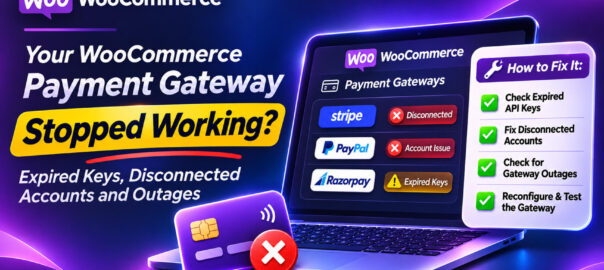
Most WooCommerce payment problems affect some orders: a stuck webhook here, a double charge there. This one is different. When the payment gateway connection itself breaks, every customer fails at the last step. Your store keeps attracting buyers, keeps filling carts, and takes no money at all.
The forums are full of variations: “Invalid secret key, please check your entry”, “There was a problem connecting to the Stripe API endpoint”, “Error: Stripe payments API key”, and threads about gateways switching to new connection methods that left stores unable to accept payments until they reconnected. WooCommerce’s own guide to failed orders lists authentication issues and expired API keys alongside card declines as a main cause of failures.
This guide covers the ways a gateway connection breaks, how to recognize each one fast, how to recover, and how to make sure you find out within minutes rather than from a customer’s angry email.
How to recognize a gateway-level failure
A gateway-level failure has a distinctive signature:
- Every payment attempt fails, or the payment form doesn’t appear at all
- Failed orders share the same error in their notes (authentication, invalid key, connection error), not varied card declines
- It started at a specific moment, often after a change
- Successful orders drop to zero for that payment method
If you see varied decline reasons (insufficient funds, expired card, incorrect CVC), that’s normal customer behaviour. If you see the same technical error over and over, it’s you.
The common causes
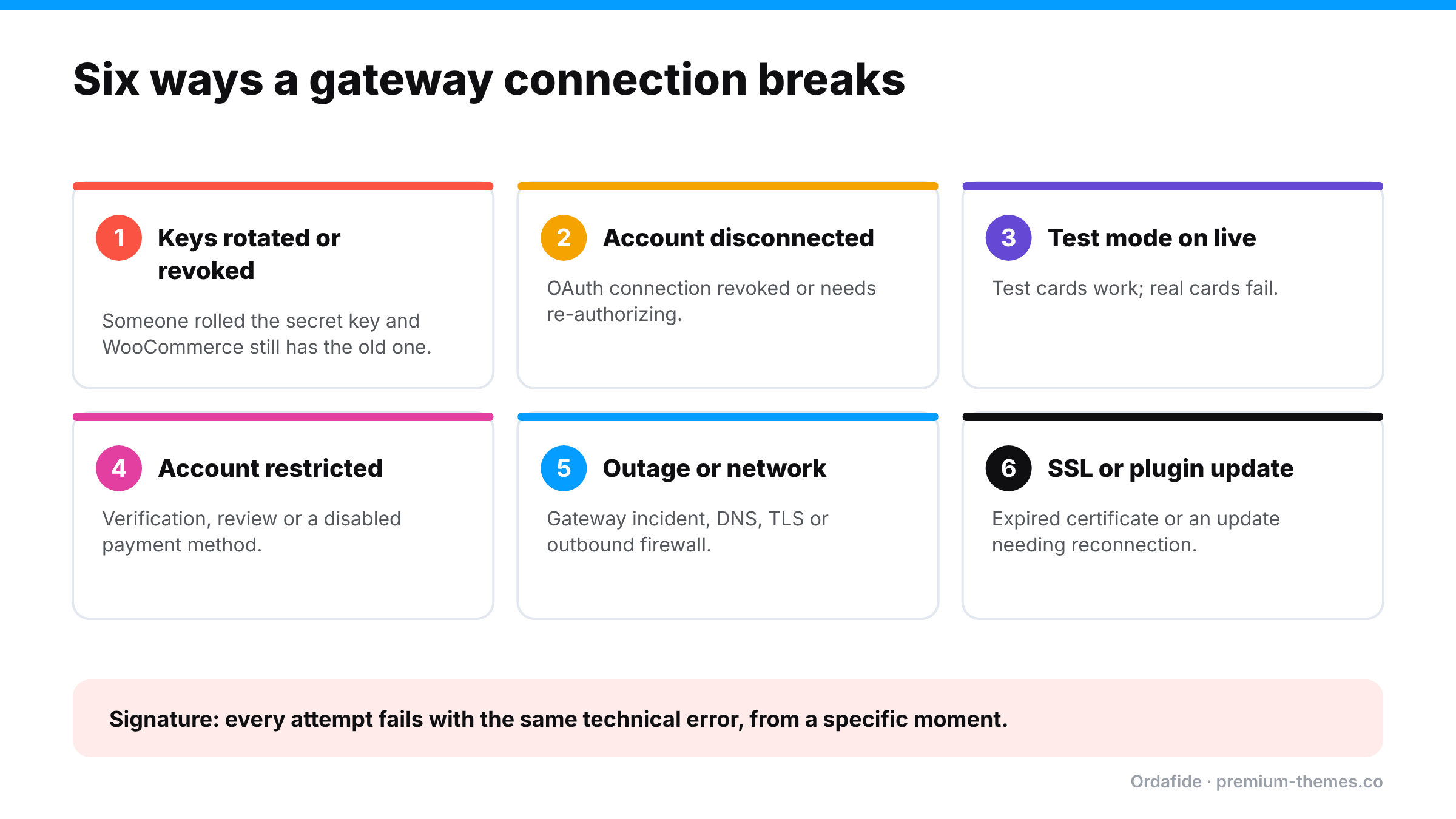
1. API keys rotated, revoked or expired
Someone regenerated the secret key in the gateway dashboard (often for security reasons, after a staff change or a suspected leak) and didn’t update WooCommerce. Or a restricted key was edited and lost a permission the plugin needs. The gateway now rejects every request.
2. The account was disconnected or needs re-authorization
Many gateway plugins now connect via OAuth (a “Connect with…” button) rather than pasted keys. Connections can be revoked, expire, or need re-authorizing when the plugin or gateway changes its integration method. Store owners discover this when payments stop.
3. Test mode on the live site (or live keys on staging)
- Test mode left on after testing: checkout appears to work for you with a test card, but real customers’ real cards are rejected (or, worse, accepted as test transactions that never charge).
- Live keys on a staging copy: real charges taken on a site you never check. (Payment received, no order)
4. The gateway account itself has a problem
Account under review, verification documents required, payouts paused, a payment method disabled, or the account closed for policy reasons. The gateway emails the account owner, and that email may be sitting in an inbox nobody reads.
5. A gateway or network outage
Gateways are very reliable, but not perfect. Regional outages, DNS problems, or your host’s network having trouble reaching the gateway’s API produce connection errors and timeouts.
6. SSL or server problems
- An expired SSL certificate: browsers warn shoppers away, and gateways’ scripts may refuse to load.
- An outdated TLS/cURL setup on the server that can’t connect to the gateway’s API.
- A firewall blocking outgoing connections from your server to the gateway.
7. Plugin update or incompatibility
A gateway plugin update that needs new settings, requires reconnection, or conflicts with your theme or checkout type. (Update broke checkout · Block checkout errors)
The 10-minute recovery
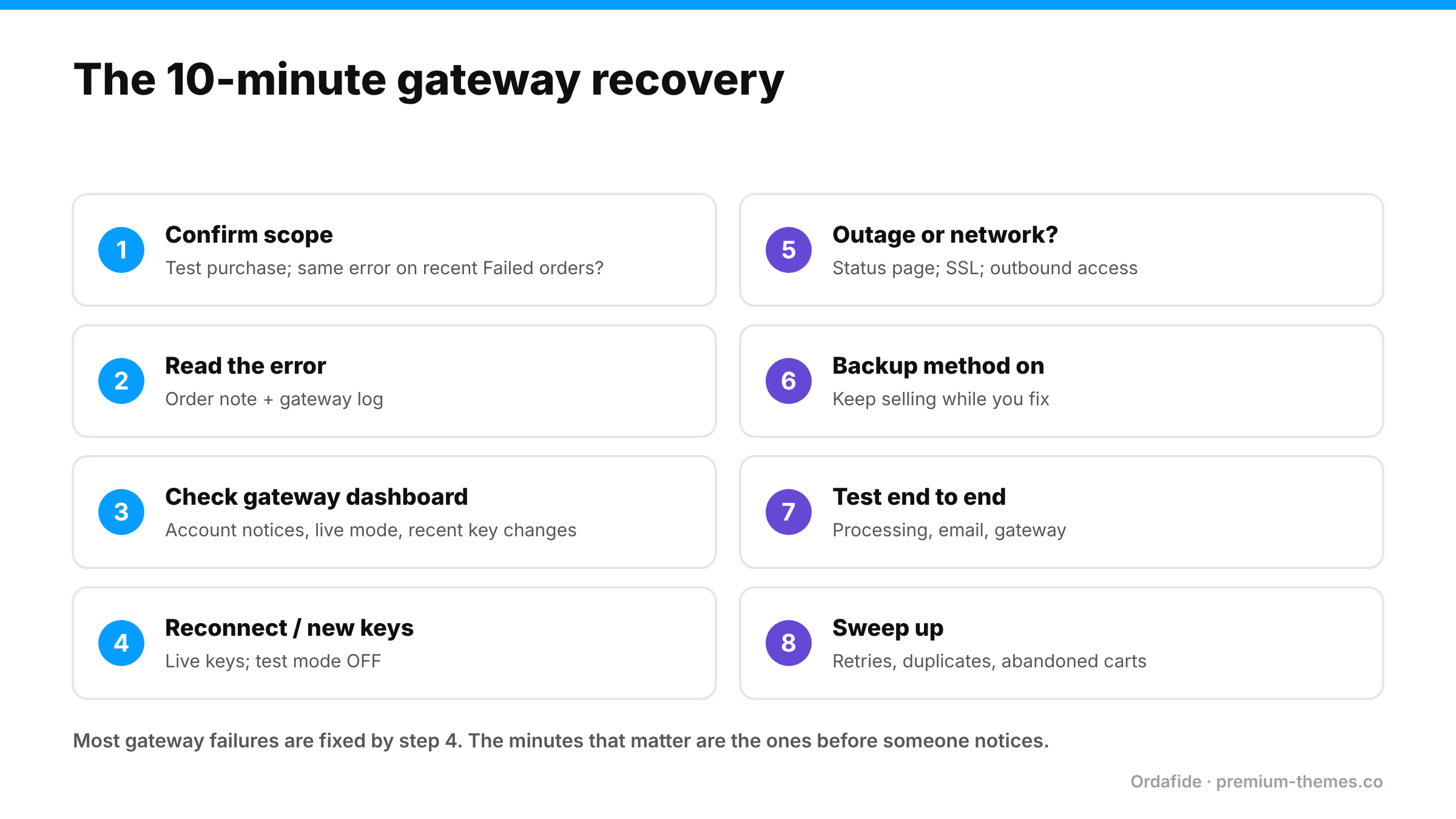
1. Confirm the scope. Place a real test purchase in a private window. Check the last few Failed orders’ notes. Same error every time?
2. Read the error. The order note or the gateway plugin’s log (WooCommerce → Status → Logs, filtered by the gateway) usually names the problem: invalid key, authentication, connection, account restricted.
3. Check the gateway dashboard. Any banners about account status, verification, disabled methods? Are you looking at live mode? Were keys regenerated recently?
4. Reconnect or re-enter keys. Use the plugin’s connect flow, or paste fresh live keys. Confirm test mode is off.
5. Check the gateway’s status page for an incident if errors are connection timeouts.
6. Check SSL and outbound connectivity if the error is about connecting rather than authenticating. Ask your host to confirm the server can reach the gateway’s API.
7. Enable a backup method if needed. If the primary gateway is down and you have a second (PayPal alongside Stripe, for example), make sure it’s enabled while you fix the first.
8. Test again end to end: order arrives in Processing, email sent, payment visible in the gateway.
9. Sweep up. Find customers who failed during the outage. Abandoned-cart emails or a personal note (“we had a payment problem, it’s fixed now”) recovers a surprising share. Check for duplicates from customers who retried.
10. Write down the cause and who to call next time.
A worked example: the key rotation
On a Friday afternoon, a store’s developer follows good security practice: a former contractor had dashboard access, so they roll the Stripe secret key. Stripe gives the option to expire the old key immediately. They choose it.
They forget that the key is pasted into the WooCommerce Stripe settings.
- From 16:40 Friday, every checkout fails with an authentication error. Customers see “There was an error processing your payment”.
- Failed orders pile up with identical notes. Cards aren’t declined; the request never got that far.
- The owner checks on Saturday evening, sees a quiet day, and assumes it’s the weekend.
- Monday 09:00: a customer phones. Reconnecting takes three minutes.
Roughly 64 hours of a store with no working payments, caused by a good security decision missing one step. With order volume monitoring, the drop would have been flagged by 18:00 on Friday.
Know your gateway’s warning signs
| Message or symptom | Likely cause |
|---|---|
| “Invalid API key” / “authentication” | Keys rotated, revoked or wrong mode |
| “No such customer” / “no such payment method” on renewals | Switched accounts or test/live mix |
| “Your account cannot currently make live charges” | Account verification or restriction |
| Connection timeout / cURL error | Network, firewall, TLS or gateway outage |
| Payment field doesn’t appear | Script blocked, SSL problem, plugin incompatibility |
| Test card works, real cards don’t | Test mode on the live site |
Prevention
- Treat API keys like passwords with an owner. Whoever rotates keys updates WooCommerce in the same sitting. Keep a short note of where every key is used.
- Make sure gateway account emails reach someone who reads them: verification requests, payout holds, disabled methods.
- Never leave test mode on. After testing, place one real low-value order to confirm live mode.
- Keep staging on test keys, always.
- Watch the SSL expiry date (or use auto-renewing certificates).
- Keep a second payment method available for outages.
- Monitor checkout and order volume automatically. A gateway failure is an absence of successful orders, and absences are exactly what people miss.
How Ordafide helps
A gateway failure doesn’t create stuck or mismatched orders so much as an absence of good ones. That’s why the most useful protection here is Pro’s monitoring.
- Synthetic checkout monitoring every 15 minutes: shop, product, cart, checkout and the Store API, with response times. It catches checkout pages that break or slow down, including when an expired SSL certificate or broken page stops shoppers reaching payment. It never places orders, and it waits for two consecutive failures before raising a finding.
- Order volume anomaly detection flags drops compared with comparable past hours. When a gateway connection breaks, successful orders fall away, and that’s the signal.
- Read-only gateway reconciliation (Stripe, PayPal, Square, Mollie, Razorpay) compares what the gateway collected with WooCommerce, which helps spot payments landing somewhere unexpected, such as live charges taken by a staging copy.
- Alerts to Slack, SMS, email or signed webhook, with severity routing, so a gateway failure on a Saturday night reaches your phone.
The free Ordafide plugin handles the clean-up. After an outage, customers retry, give up, and retry again. Ordafide’s duplicate charge, stuck payment and paid but cancelled checks find the orders caught mid-failure, and the Customer never emailed check finds paid customers who never got a confirmation.
Ordafide doesn’t hold or manage your gateway credentials for payments. Pro’s reconciliation uses read-only keys and can’t capture, refund or void anything.
Building a simple gateway runbook
Write one page, store it somewhere everyone can find it, and include:
- Which gateways you use, which payment methods each provides, and which is the backup.
- Who owns each gateway account and who can log in.
- Where the keys are used (WooCommerce, other plugins, other systems) and the steps to rotate them safely.
- The gateway’s status page and support contact.
- The first five checks from the recovery section above.
- Who to tell when payments fail: team, customers, ads.
When payments stop at 11 p.m. on a Saturday, a runbook turns panic into a ten-minute fix.
After an outage: the clean-up checklist
- Failed orders during the outage reviewed. Any actually paid?
- Duplicate orders from customers who retried, refunded from the duplicate order
- Abandoned carts from the outage period contacted
- Paid orders without confirmation emails found and resent
- Gateway dashboard checked for charges with no matching order
- Ads reviewed: spend during the outage, and whether to adjust budgets
- Cause documented and the runbook updated