WooCommerce Returns
Handcrafted Beautiful Bootstrap HTML Templates for your Business Website.
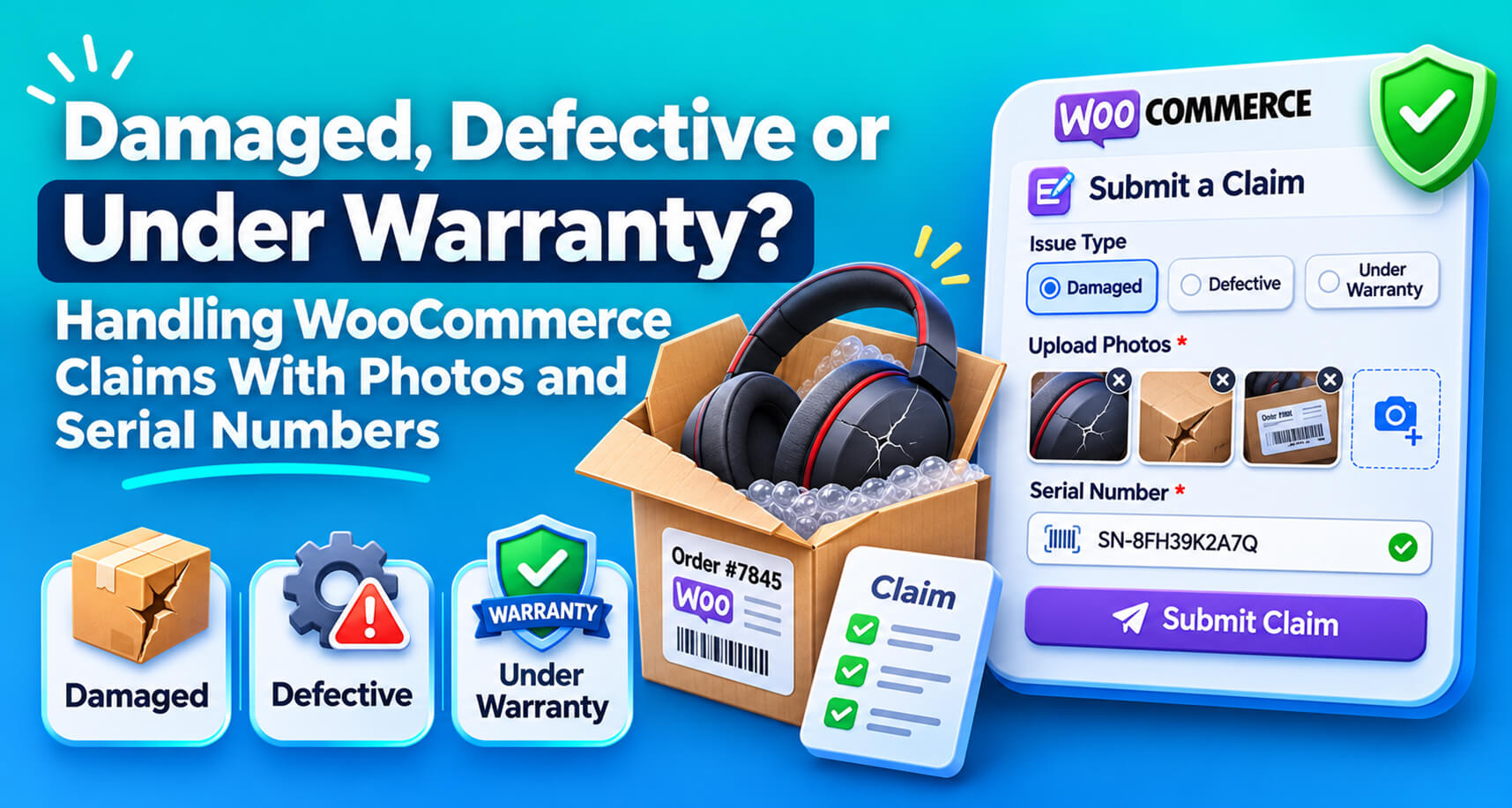
Not every return is a change of mind. Some of the most important ones are claims:
These are the returns where getting it right matters most. The customer has a genuine grievance, often a legal right, and usually a short fuse. Handle it well and you keep a customer who trusts you. Handle it badly (slow, sceptical, endless emails asking for photos) and you get a chargeback, a public review, or both.
They’re also the returns most open to abuse. “Damaged on arrival” is an easy claim to make and a hard one to disprove without evidence.
This guide sets out a claims process for WooCommerce that’s fast for genuine claims, consistent for your team, and evidence-based enough to deter abuse.
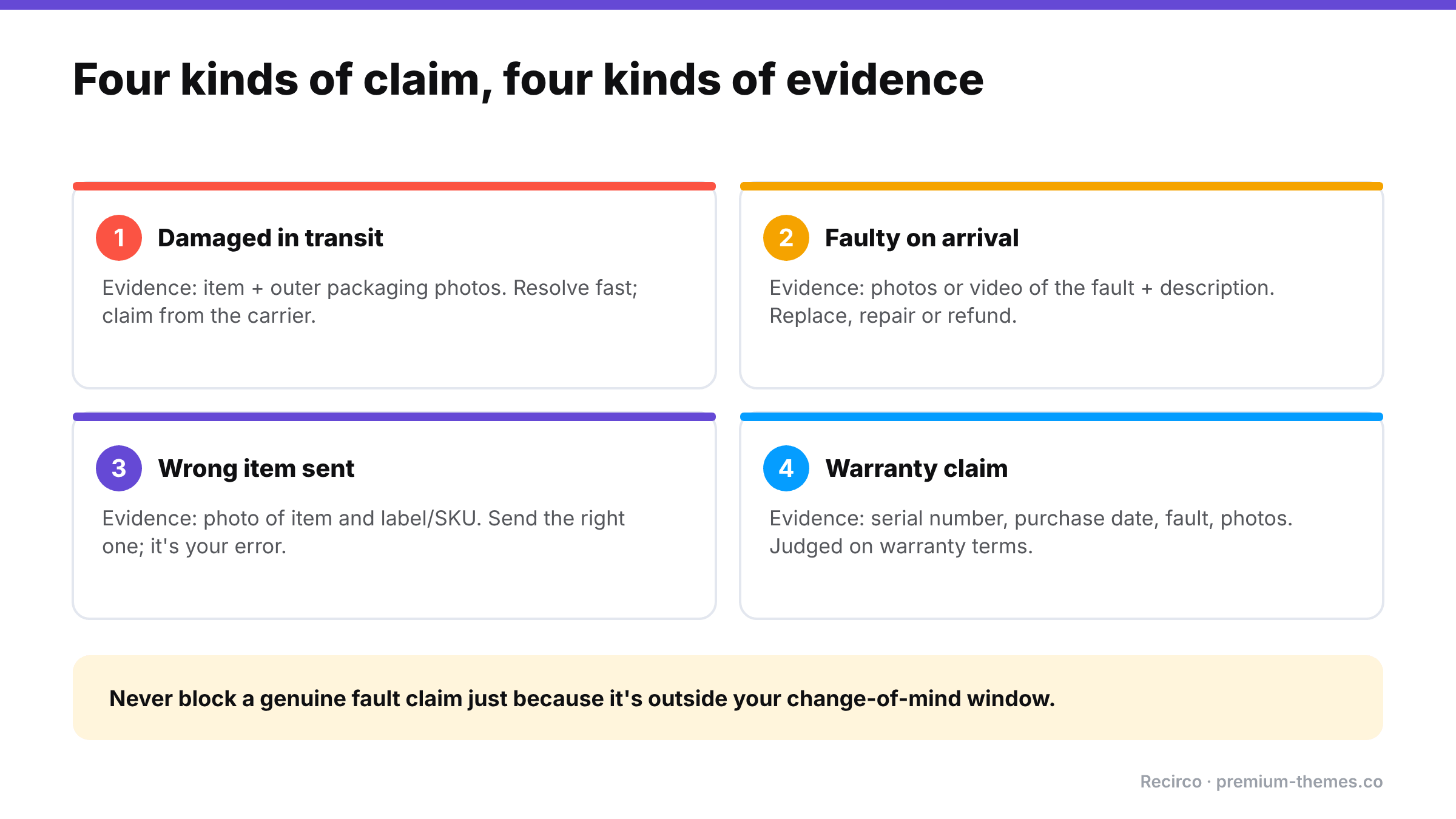
| Claim | Typical timing | Key evidence | Usual resolution |
|---|---|---|---|
| Damaged in transit | Days after delivery | Photos of item and packaging | Replacement or refund; carrier claim |
| Defective / faulty on arrival | First days or weeks | Photos/video of fault; description | Replacement, repair or refund |
| Wrong item sent | Days after delivery | Photo of item and label/SKU | Correct item sent; return or keep the wrong one |
| Warranty claim | Months later | Proof of purchase, serial number, fault description, photos | Repair, replacement, or refund per warranty terms |
Mixing them into one generic “return” flow causes problems. A warranty claim 11 months after purchase shouldn’t be rejected because it’s outside your 30-day return window. A damaged-in-transit claim shouldn’t wait until the broken item is posted back before you act.
Your warranty and your return window are not the only rules that apply. In many markets, consumer law gives buyers rights for faulty goods regardless of your policy:
This is general information, not legal advice. Check the rules for each market you sell to.
The practical takeaway: your claims process should never block a legitimate fault claim just because it’s outside your change-of-mind return window.
A customer with a broken item shouldn’t have to compose an email. Offer clear reasons in your returns portal:
Make a description required for each, so you get “the left hinge snapped when opening the box” rather than “broken”.
The single biggest time-waster in claims handling is the follow-up email: “Could you send a photo?” Ask for photos as part of the claim, and say exactly what you need:
For electronics, appliances, tools and anything with a meaningful warranty, record serial numbers. They let you:
Collecting a broken $15 item can cost more in shipping than the item is worth. Set a threshold:
These are almost always your problem (or your carrier’s), and the customer did nothing wrong. Aim to approve within one working day and ship the replacement promptly. Use the photos to file the carrier claim yourself.
Reason, description, photos, serial number, decision, who made it, and what was sent or refunded. When the same customer claims again, or a supplier asks for evidence, it’s all in one place.
Claims are product feedback with photos. If one product has repeated “faulty” claims, talk to the supplier. If “damaged in transit” clusters on one carrier or one packaging type, change it.
Compare two versions of the same claim reaching your team.
Email version: “Hi, my order arrived broken. Please help.” No order number, no photos, no detail. Your team replies asking for the order number and photos. The customer replies two days later with one blurry photo. You ask for a photo of the packaging. They’ve thrown it away. Five emails and a week later, you send a replacement anyway, without evidence for a carrier claim.
Portal version: order #7731 selected automatically from the customer’s account; item “Ceramic table lamp”; reason “Damaged in transit”; required description “Base cracked into two pieces, box crushed on one corner”; four photos attached: lamp, crack close-up, outer box, shipping label. Your team approves in two minutes, ships a replacement the same day, and files the carrier claim with the photos already in hand.
Same customer, same broken lamp. The second version took a fraction of the time, kept the customer happy, and recovered the cost from the carrier.
Every claim is a data point. Reviewed monthly, claims data answers questions that are otherwise expensive to investigate:
A claims process that captures structured reasons, photos and serials turns this from guesswork into a ten-minute monthly review.
When an item is damaged in transit, the cost usually belongs to the carrier, if you can prove it. Carriers typically want the claim filed within a set period, photos of the damaged item and the packaging, the tracking number, and proof of the item’s value. Some want the packaging kept for inspection. Because a good claims process collects photos and the order details at the moment the customer reports the damage, you can file the carrier claim the same day instead of chasing evidence weeks later.
A good claims process deters most abuse simply by asking for specific evidence consistently. Beyond that:
What you shouldn’t do is make every customer jump through hoops because of a few bad actors. (More on this in return fraud and serial returners.)
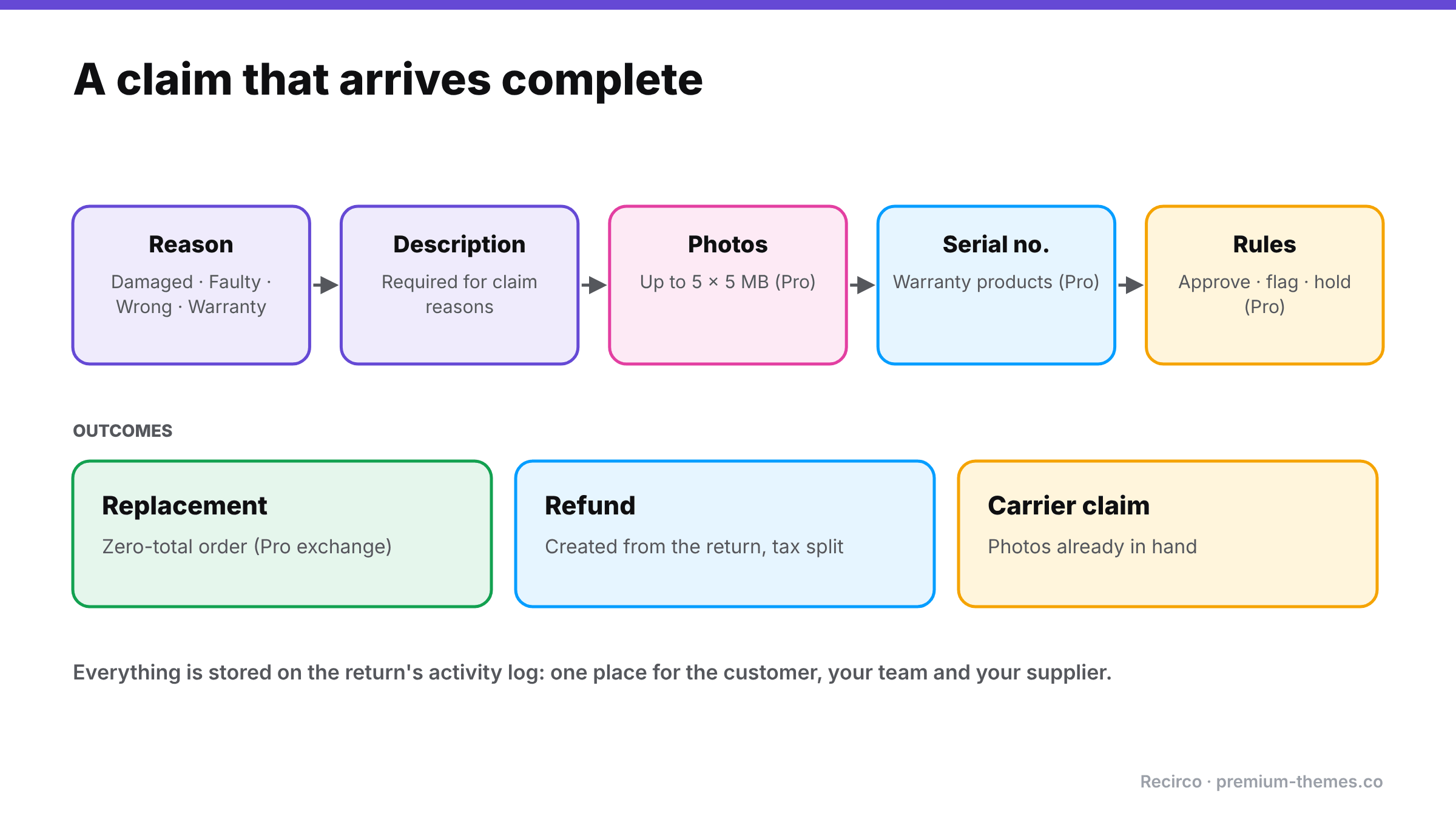
Recirco – Returns & Exchanges for WooCommerce (free) gives you the foundation:
Recirco Pro adds the claims-specific tools:
Damaged, faulty or wrong items
If your order arrives damaged, faulty or isn’t what you ordered, start a claim from My Account → Returns within [7] days of delivery. Choose the matching reason, describe the problem, and attach photos of the item and its packaging. We’ll respond within one working day and send a replacement or refund at no cost to you. For items under [$25], you won’t need to send anything back.
Warranty claims
Products marked with a warranty are covered for [12 months] from the date of purchase. Register your serial number in your account. To claim, choose “Warranty claim”, enter the serial number, describe the fault and attach photos. If we need the item back, we’ll email you a prepaid label.
This policy doesn’t affect your statutory rights.
How should I handle a customer saying their item arrived damaged?
Ask for photos of the item and the outer packaging as part of the claim, resolve quickly with a replacement or refund, and use the photos to claim from your carrier.
Do I have to accept defective items after my return window?
Often yes. Consumer law in the EU, UK, Australia and elsewhere gives rights for faulty goods well beyond a typical change-of-mind window. Check the rules where you sell.
Can WooCommerce collect photos with a return?
Not natively. Recirco Pro lets customers attach up to five photos per claim.
How do I track warranties and serial numbers in WooCommerce?
Recirco Pro sets a warranty length per product, lets customers register serial numbers, and calculates cover from the purchase date.
Should damaged items be restocked?
Not automatically. Inspect first. Set restocking to manual (never) for damage and fault reasons and decide case by case.
Do I need the damaged item back?
Not always. For low-value items, photos are usually enough and return shipping can cost more than the item. For high-value items, or when you need to claim from a supplier, ask for it back with a prepaid label.
How quickly should I respond to a damage claim?
Within one working day if you can. Transit damage and wrong items are rarely the customer's fault, and a fast response prevents disputes and bad reviews.