On this page
- The core principle: refund what was actually paid for the item
- Scenario 1: Percentage coupon on the whole order
- Scenario 2: Fixed-amount coupon on the cart
- Scenario 3: The return breaks a minimum-spend discount
- Scenario 4: Buy one, get one free (BOGO)
- Scenario 5: Bundles and kits
- Scenario 6: Gift with purchase
- Scenario 7: Free shipping threshold
- Scenario 8: Store credit or gift card used as payment
- Why getting this right matters more than it looks
- Explaining an adjusted refund to the customer
- Turning rules into defaults
- How Recirco helps
- Policy wording you can adapt
Returning a full-price item from a single-item order is easy: refund what they paid.
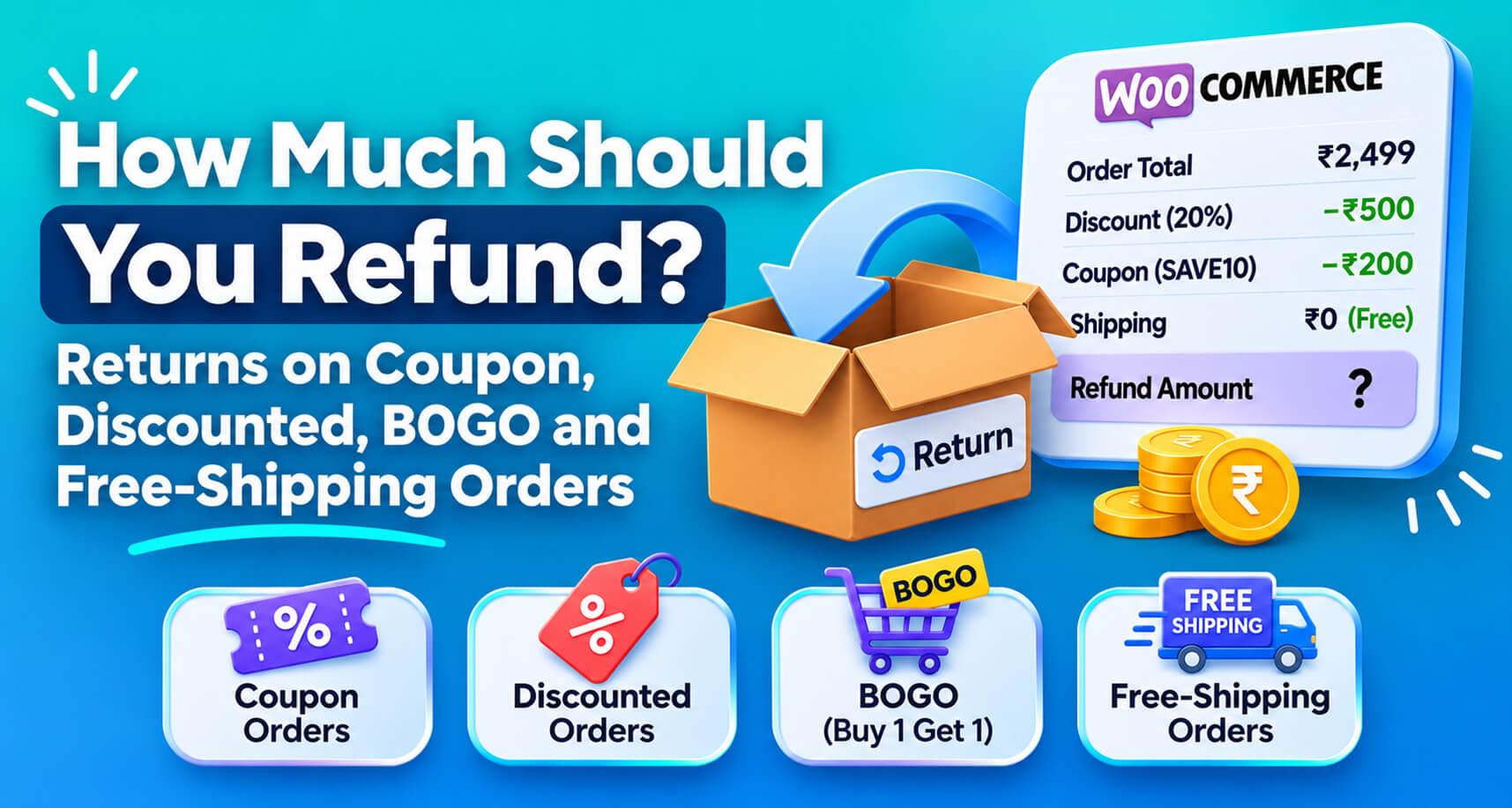
Now try this one. A customer used a 20% off coupon on a three-item order that qualified for free shipping over $75. They return one item. The remaining two now total less than $75. How much do you refund?
Or: a buy-one-get-one-free deal, and they return the paid one. Or the free one. Or a gift-with-purchase promotion where they keep the gift and return the purchase.
These questions trip up store owners and support teams every day, and the answers you give can quietly cost you money (over-refunding) or customers (under-refunding and arguing). This guide works through the common discount scenarios, the principles behind fair refunds, and how to make the right amount the default.
This is practical guidance, not legal advice. Consumer law in some places sets rules on refund amounts, especially for faulty goods and statutory withdrawal rights. Check the rules where you sell.
The core principle: refund what was actually paid for the item
The fairest, most defensible rule is simple:
Refund the amount the customer actually paid for the returned item, after its share of any discount, plus or minus any shipping your policy says.
Not the list price. Not the order total divided by the number of items. The item’s share of what was paid.
The good news: WooCommerce already works this way for coupons. When a coupon is applied, WooCommerce spreads the discount across the eligible line items and stores each line’s subtotal (before discount) and total (after discount). The refund form pre-fills from the line total, the discounted amount actually paid for that line. As long as you refund through the line items rather than typing an amount, you start from the right number.
Scenario 1: Percentage coupon on the whole order
Order: 3 items at $40 each = $120. Coupon 20% off → $24 discount. Paid: $96.
Return: 1 item.
WooCommerce allocates the discount to each line: each item’s line total is $32.
Refund: $32 (plus that line’s tax, if any).
Common mistake: refunding $40, the shelf price. That over-refunds by $8 per item, and on a busy sale weekend that adds up.
Scenario 2: Fixed-amount coupon on the cart
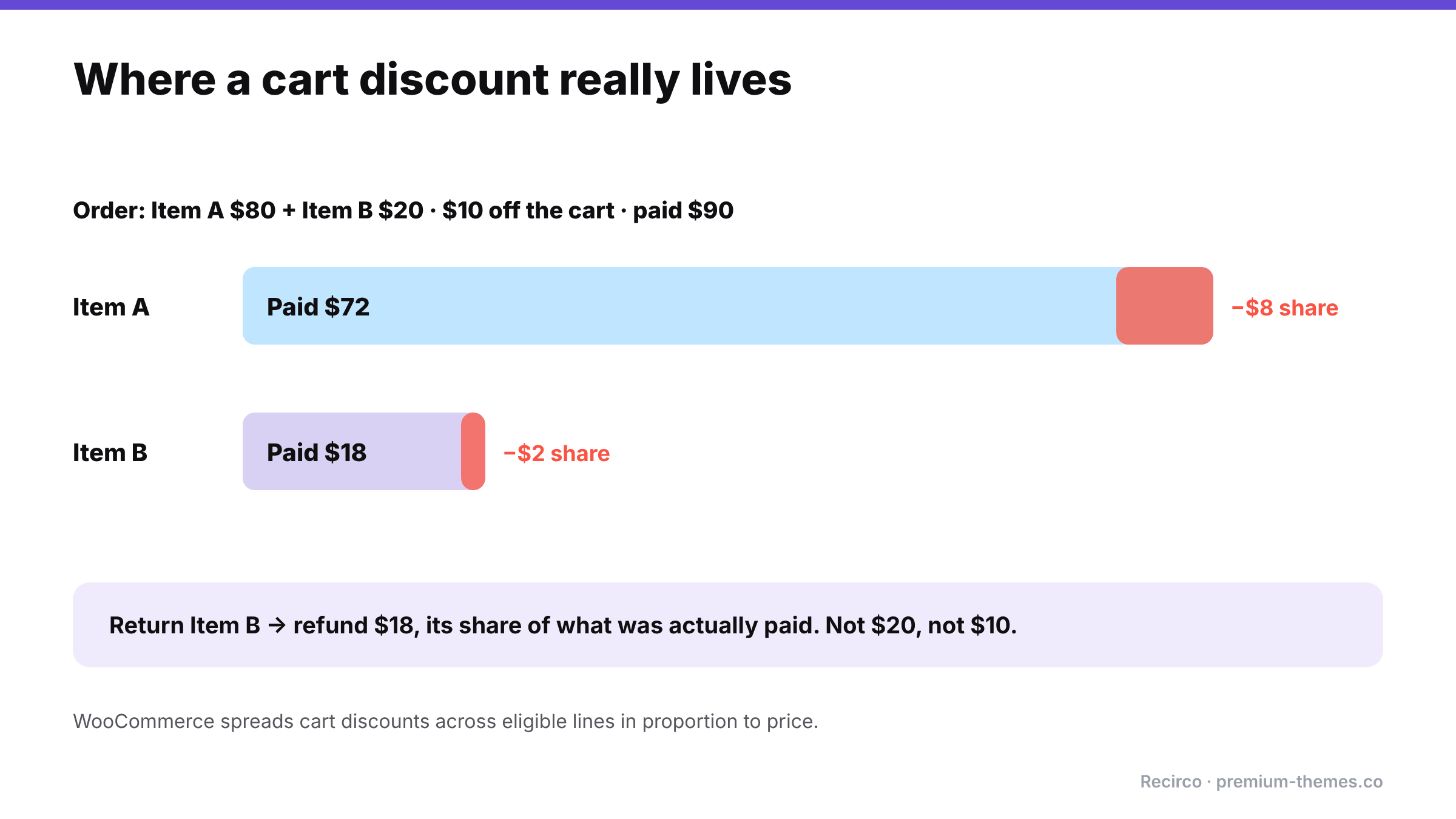
Order: Item A $80 + Item B $20 = $100. Coupon $10 off cart. Paid: $90.
Return: Item B.
WooCommerce spreads a fixed cart discount across the eligible items in proportion to their price: A gets $8 of the discount, B gets $2. B’s line total: $18.
Refund: $18.
Why proportional is fair: if you gave B the whole $10 discount, you’d refund only $10 and the customer would feel cheated. If you gave none, you’d refund $20 and lose the $2 they never paid.
Scenario 3: The return breaks a minimum-spend discount
Order: 3 items at $30 = $90. Coupon “$15 off orders over $75”. Paid: $75.
Return: 1 item. The remaining $60 no longer qualifies for the coupon.
Two defensible approaches:
- Proportional (simplest, most common): refund the returned line’s discounted amount: $25. The customer keeps the full benefit on the remaining items.
- Recalculate (strict): the customer would have paid $60 for the two items they kept, without the coupon. They paid $75. Refund $15.
The strict approach is logically defensible, but customers often see it as a penalty, and it generates complaints. Many stores choose proportional for goodwill and simplicity. Whichever you choose, put it in your return policy (“Discounts that depended on a minimum spend may be adjusted if items are returned”) so it isn’t a surprise.
Scenario 4: Buy one, get one free (BOGO)
Order: 2 items at $30, “buy one get one free”. Paid: $30.
Return: 1 item.
How the BOGO plugin recorded the discount decides the default:
- If it put a $30 line and a $0 line, refunding the free one gives $0 and refunding the paid one gives $30. The customer effectively gets the “free” one for nothing either way.
- If it spread the discount (two lines at $15), each item refunds at $15.
Fair approach: treat BOGO as 50% off each item. Returning one item refunds half of what was paid ($15). The customer keeps one item for $15, which is fair since they no longer meet the “buy two” condition.
Policy tip: state it plainly: “Items bought on multi-buy offers are refunded at the price paid per item under the offer.”
Scenario 5: Bundles and kits
Order: “Starter kit” bundle of 3 products for $99 (worth $130 separately).
Return: 1 product from the kit.
If the bundle is sold as a single product, you either accept only whole-kit returns, or refund a defined portion. If it’s sold as separate line items with a bundle discount, refund the returned line’s share of the discounted price, like Scenario 2.
Policy tip: many stores make bundles returnable only as complete bundles. If that’s your rule, enforce it by making individual bundle components non-returnable through your returns system rather than arguing case by case.
Scenario 6: Gift with purchase
Order: $70 serum + free travel bag (gift with purchases over $60). Paid: $70.
Return: the serum, keeping the bag.
Fair approaches: ask for the gift back too, or deduct its value from the refund, or let it go for low-value gifts. Most stores let low-value gifts go to avoid friction, and state that gifts over a certain value must be returned with the qualifying item.
Scenario 7: Free shipping threshold
Order: 2 items totalling $80 with free shipping over $75. Paid: $80.
Return: a $30 item. The kept item ($50) wouldn’t have qualified.
Options:
– Ignore it (most common): shipping was free, nothing to adjust.
– Deduct standard shipping from the refund, since the customer no longer qualifies. This is legitimate if stated in your policy, but it’s a frequent source of complaints.
Also decide whether you refund shipping paid by the customer when they return everything. In the EU, a consumer withdrawing from a distance contract is generally entitled to a refund of the standard delivery cost (not premium delivery they chose). Elsewhere it’s your policy choice.
Scenario 8: Store credit or gift card used as payment
If part of the order was paid with store credit or a gift card, refund in the same proportions by default: card portion back to card, credit portion back as credit. That stops customers converting non-refundable credit into cash through returns.
Why getting this right matters more than it looks
The difference between refunding list price and refunding the price paid seems small on one return. Across a sale season it isn’t.
Suppose you run a 25%-off Black Friday sale, sell 2,000 items averaging $40, and see a 15% return rate: 300 returned items. If each is refunded at the $40 list price instead of the $30 actually paid, you’ve given away $3,000 you never received. That money comes straight out of margin, on top of the cost of handling the returns.
The opposite mistake costs too. Under-refund (deduct discounts the customer doesn’t understand, or argue over pennies) and you buy yourself support tickets, bad reviews and occasionally a “credit not processed” chargeback, which costs a dispute fee on top of the refund you end up giving anyway.
Consistent, explainable rules avoid both.
Explaining an adjusted refund to the customer
When your policy means refunding less than the customer expects, say so before they’re surprised by their bank statement. A short note works:
“We’ve refunded $25.00 for the returned item. That’s the amount you paid for it after your 20% discount code. The other two items keep their discount. Your refund should appear within 5–10 working days.”
Customers rarely argue with a clear explanation. They argue with a number they don’t understand.
Turning rules into defaults
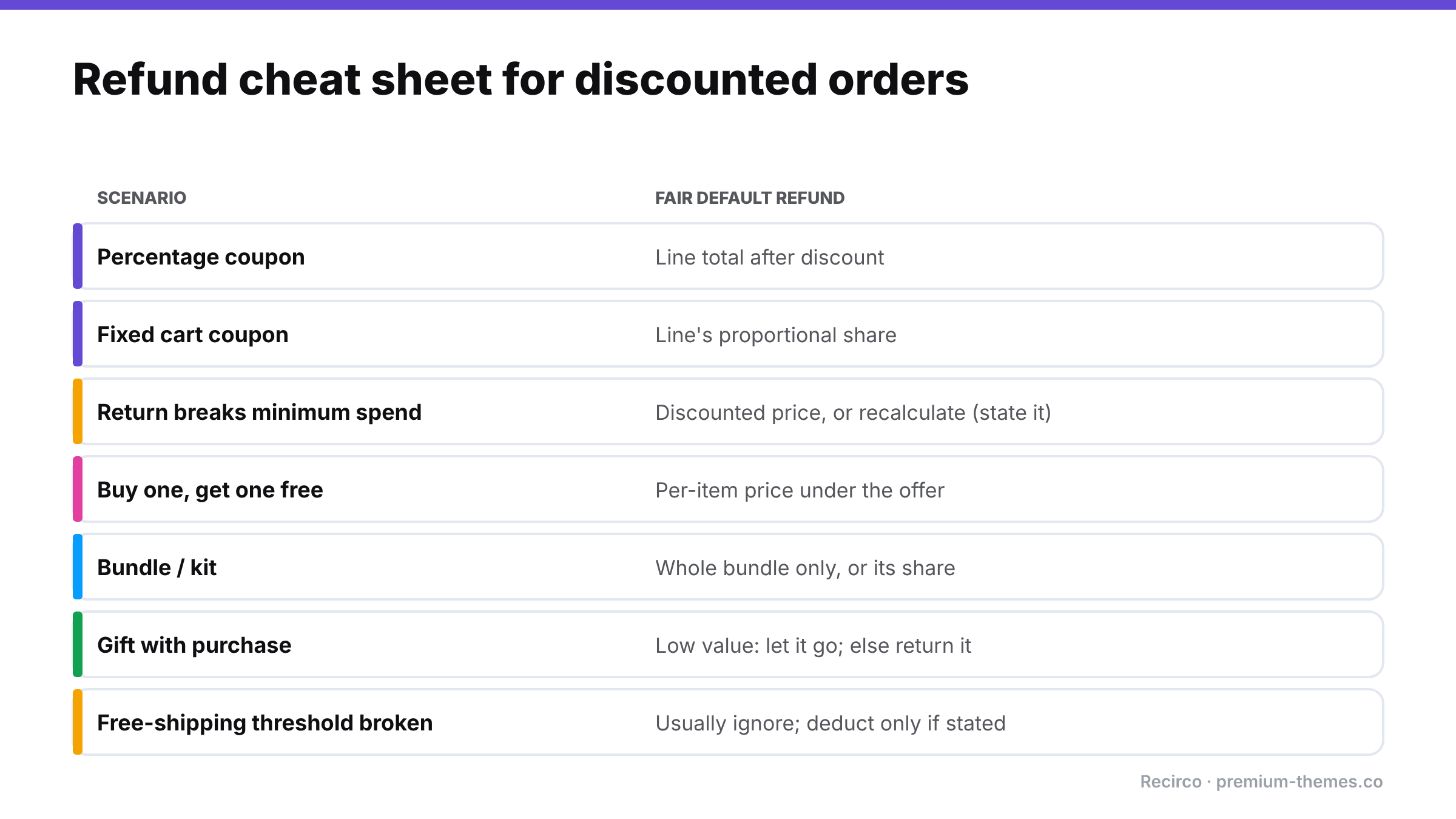
The scenarios above are manageable when one experienced person handles every return. They fall apart when several people handle returns, each doing their own arithmetic.
Three practices keep refunds consistent:
- Always refund through line items, never by typing an amount into the total. WooCommerce’s line totals already include coupon allocation, and the refund form splits net and tax.
- Write the edge cases into your policy: minimum-spend discounts, BOGO, bundles, gifts, free-shipping thresholds. Then support can point to it.
- Create refunds from the return record, so the system that knows which units came back also creates the refund for those units.
How Recirco helps
Recirco – Returns & Exchanges for WooCommerce is a free returns portal and approval queue that takes the arithmetic out of individual hands:
- Customers return specific items and quantities, chosen from their order in My Account → Returns. Only eligible units are offered.
- Refunds are created from the return as genuine WooCommerce refunds for the returned lines, with net and tax split from the original line, so they start from the discounted amount actually paid, not the shelf price. You can still adjust the amount before refunding when your policy says so (for example, deducting a broken minimum-spend discount). Send it through the gateway or record it manually.
- Excluded products and categories, so bundles you only accept as complete sets, final-sale items or gifts can be made non-returnable in the portal itself.
- Duplicate-refund prevention, so the same returned unit can’t be refunded twice.
- Notes: internal for your team, or sent to the customer, so you can explain any adjustment in writing.
- Policy text shown in the portal, so customers see your rules on discounts and gifts before they submit.
Recirco Pro adds exchanges (often the best answer for discounted items, since a size swap keeps the original deal intact), store credit with optional bonus, and conditional approval rules to flag returns from high-value or heavily discounted orders for a closer look.
Policy wording you can adapt
Returns on discounted and promotional orders
- Refunds are for the amount you paid for each item after any discount.
- If a discount depended on a minimum spend or number of items and your return takes the order below it, [we’ll still refund the full amount you paid for the returned items / the refund may be adjusted to reflect the discount you no longer qualify for].
- Items bought on multi-buy offers (e.g. buy one, get one free) are refunded at the price paid per item under the offer.
- Bundles can only be returned complete.
- Free gifts worth more than [$20] must be returned with the item that qualified for them.
- Free shipping is [not deducted / deducted at our standard rate] if a return takes your order below the free-shipping threshold.
Frequently asked questions
Do I refund the full price if the customer used a coupon?
No. Refund the amount actually paid for the item after its share of the discount. WooCommerce's line totals already reflect this, so refunding through the line items gives the right starting figure.
What if a return means the customer no longer qualifies for a discount?
You can either refund the item's discounted price (simplest, most customer-friendly) or recalculate what they'd have paid without the discount. State your choice in your return policy.
How do I refund a BOGO item?
Treat the deal as a discount spread across both items and refund the per-item price paid under the offer.
Should I refund shipping when a customer returns one item?
Usually not for partial returns, unless the return is your fault. In the EU, a full withdrawal generally entitles the customer to a refund of the standard delivery cost.
Can I refund less than the customer paid because they no longer qualify for a discount?
You can if your policy says so clearly and local law allows it, but many stores choose to refund the full discounted price paid for simplicity and goodwill.